Disturbances in body chemistry commonly develop during many forms of illness and following surgery. If left untreated they can lead to death. NHMRC-funded researchers at the University of Melbourne and The Florey Institute made major contributions to understanding how the body regulates its electrolytes and water balance and to introducing practical methods for measuring and managing these processes in patients. This work laid the foundations of modern intensive care and also underpinned the development of widely used medicines for hypertension, heart and kidney disease, improving health outcomes in Australia and internationally.
Origin
In 1947, when recent medical graduate Derek Denton commenced work at Royal Melbourne Hospital (RMH), little was known about how body chemistry affected patient health and disease, and some of what was thought was in fact dangerously incorrect.
There was also limited use of scientific methods within hospitals for chemical testing. Training for clinicians didn’t include much instruction in chemistry, and even where knowledge and a correct understanding did exist, clinicians were not able to quickly and accurately measure the chemical composition of body fluids.1
All this became clear to Denton when, soon after he started at the hospital, he was treating a patient who needed to have the contents of his stomach constantly drained through a tube. The tube began draining two to four litres of highly alkaline fluid every day, causing the patient’s blood to become too acid. However, when Denton measured the chloride content of the patient’s urine, he found that it was increasing, even though chloride would normally be conserved by the body to prevent acidosis.
The patient eventually died and Denton published the results of this case in the prominent international scientific journal Nature. In this article he called into question both existing theory and medical practice and suggested that qualitative analysis and quantitative record of the electrolytes that the body was losing was essential to improving patient outcomes. Understanding body chemistry and its regulation became the long-term focus of Denton’s research.
Investment
Over several decades, NHMRC funded a team of researchers at the University of Melbourne and then at the Florey Institute that included Denton, Victor Wynn, Douglas Wright, Judith Whitworth, Bruce Scoggins and John Coghlan.
This team’s research was also supported by grants from the US National Institutes of Health, the Myer, Packer, Kleberg and Rothschild families, the Ian Potter Foundation and the Rockefeller Foundation.
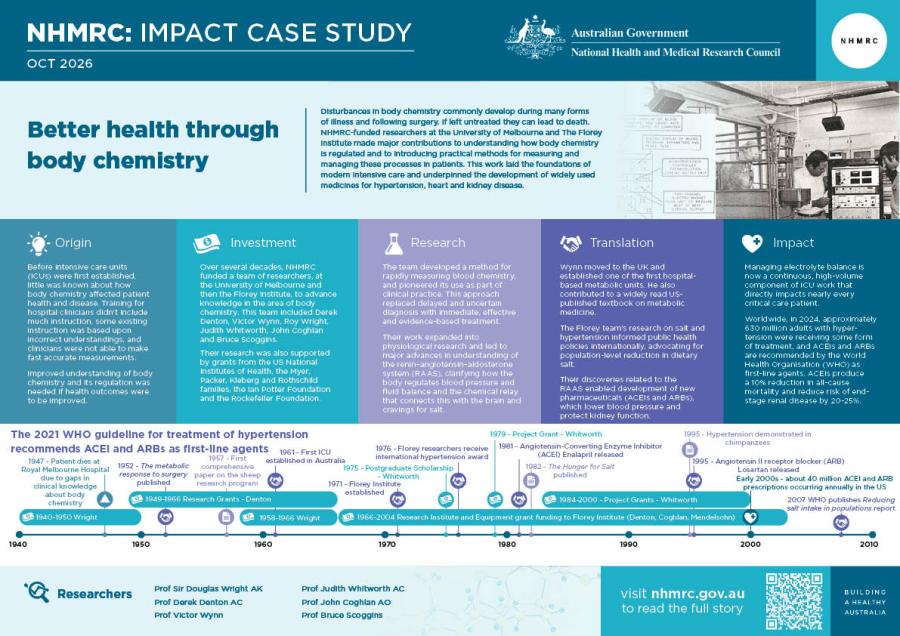
The PDF poster version of this case study includes a graphical timeline showing NHMRC grants provided and other events described in the case study.
Research
Intensive care
In 1949, Wright, Denton and colleague Victor Wynn established an Ionic Research Unit (IRU) within the University of Melbourne’s NHMRC-funded Department of Physiology. Hospitals at the time lacked a systematic way to monitor or treat severe biochemical imbalances. As a result, critically ill patients recovering from surgery, suffering from severe dehydration or diabetic comas frequently died of chemical shock. Clinicians were often forced to guess their patients’ electrolyte status because available tests took days to process.
The team revolutionised clinical practice by adapting a flame photometer – originally built for soil analysis in agriculture – to measure blood plasma chemistry. This breakthrough reduced measurement times from days to minutes and allowed Wynn and Denton to replace assumptions with evidence-based, tailored therapy. To immediately translate this innovation into patient care, they formed a mobile emergency service, driving laboratory equipment directly to hospital wards in Wynn's car, and then treating critically ill patients based upon body chemistry measurements undertaken on-the-spot.
While this was a major advancement, the IRU team realized that further clinical progress demanded a much deeper understanding of the internal physiological processes that determined and influenced body chemistry.
Hormonal regulation
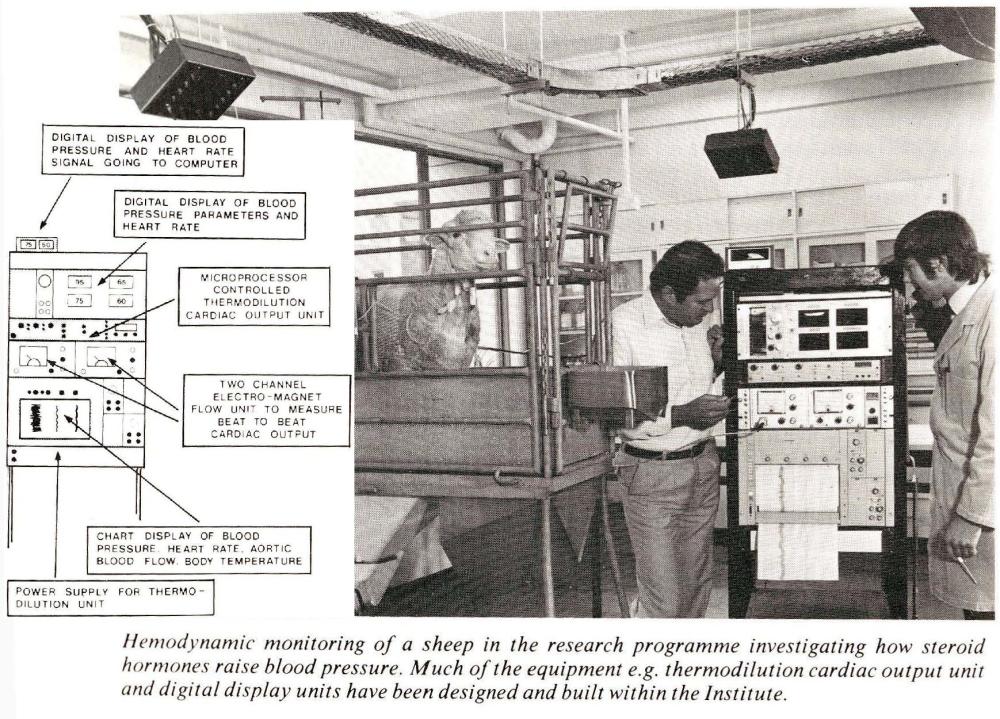
A breakthrough came when the IRU was consulted by a research veterinarian from CSIRO’s Animal Health Division about some sick sheep. Wynn determined that the problem was acute acidosis and this led to the realisation that, because of the large amount of extremely alkaline saliva that sheep produce, studying their electrolyte balances was much easier than studying these balances in humans.
Supported by an NHMRC travelling grant, Denton travelled to the UK to study animal experimentation at Cambridge University under Professor of Pharmacology, E Basil Verney, a world-leading expert in renal physiology and hormone regulation.
Returning to Australia in 1953, Denton and his colleagues began to study how the electrolyte and hormone contents of sheep saliva, blood and urine changed in response to a variety of stimuli and to hormones such as aldosterone. The first comprehensive summary of this work, published by Denton in 1957, became a ‘citation classic’.2
Blood pressure control
Over time the Florey team made significant contributions to understanding what is now known as the Renin-Angiotensin-Aldosterone System (RAAS), which is the body’s hormone chain reaction for controlling blood pressure and fluid balance.
Within the RAAS, when blood pressure drops or salt levels are deficient, the kidneys release an enzyme called renin into the bloodstream. Renin acts like a pair of scissors, clipping a floating blood protein to create a weakly-acting hormone called angiotensin I. A second chemical, known as angiotensin-converting enzyme (ACE) then transforms this into another hormone: angiotensin II.
The Florey group’s whole‑animal studies provided critical physiological evidence that angiotensin II is a key physiological intermediary between the kidney and the adrenal glands. It stimulates the adrenal glands to release aldosterone, which signals the kidneys to retain salt and water and excrete potassium. Together, these processes increase blood volume and raise blood pressure.
The Florey team also mapped how this entire chemical relay connects with the brain, controlling both physical survival and behavioural cravings for salt.
Translation
Clinical control of body chemistry
The IRU is now recognized as an origin point in the global development of modern intensive care units (ICUs), having pioneered a key function of an ICU well before the first such unit was formally established in Australia in 1961. In 1950, Wynn moved to St Mary’s Hospital Medical School in London where, in 1953 and at his instigation, the hospital approved plans to set up a metabolic unit. In time Wynn established an entire metabolic ward at St Mary’s.3
Following discussions with Wynn, Professor Francis Moore of Harvard University incorporated the IRU team’s system for classifying the distortion of body fluid status in his textbook, The Metabolic Response to Surgery. This textbook became a foundational work in surgical physiology used by surgeons internationally and established the modern understanding of the body’s metabolic response to surgical trauma.4
Disturbances in body chemistry are now understood to be among the most common clinical problems encountered in an ICU. To provide optimal care in a modern hospital, ICU staff must be familiar with the principles and practice of body chemistry physiology and pathophysiology.5
Salt and hypertension
Denton’s 1982 book, The Hunger for Salt, brought together evidence that salt appetite is a key mechanism through which the body maintains sodium balance and fluid homeostasis. The book integrated physiological, endocrine and behavioural research and became a foundational reference for subsequent work on sodium regulation, hypertension and salt appetite.6
In a 1995 article, Denton and colleagues provided direct experimental evidence that increasing dietary salt intake causes a sustained rise in blood pressure. The study showed that when the salt intake of chimpanzees (which are closely related to humans) was increased, their blood pressure rose significantly. The effect was reversible: when salt intake was reduced, blood pressure declined accordingly. The magnitude of the change was large enough to be clinically meaningful and comparable to effects observed in humans.7 The study was widely regarded as strong experimental support for the role of high salt intake in causing hypertension and has informed public health policies advocating population-level reduction in dietary salt.
Angiotensin II
The discovery by the Florey team of what Angiotensin II does in the body was essential to the development of drugs called ACE inhibitors (ACEIs – such as Enalapril – released in 1981) and Angiotensin II receptor blockers (ARBs – such as Losartan, released in 1995).
By blocking angiotensin II’s powerful vasoconstrictive (blood vessel narrowing) properties, these therapies relax blood vessels, lower systemic blood pressure and reduce the workload on the heart. Drugs targeting angiotensin II can also be used to halt the progression of chronic kidney disease by lowering fluid pressure within the kidney. They can delay or completely prevent the transition to end-stage renal failure and the subsequent need for dialysis.
Outcomes and impacts
Intensive care units
In a 1950 paper providing arguments for and details on the use of flame photometry in medicine, Wynn, Denton and colleagues concluded by prophesizing, ‘We look forward confidently to the time when flame photometry will become a widely used technique, and to the more vigorous participation of the clinical biochemist in the treatment of the severely ill patient’.8 This prediction turned out to be an understatement. Over the next two decades – and until they were replaced by superior technology – flame photometers, ‘saved more lives than all the other clinical chemical devices put together’.9
Managing electrolyte balance is now a continuous, high-volume component of ICU work that directly impacts nearly every critical care patient. Critically ill patients very often present with or develop a body chemistry imbalance during their stay and usually receive intravenous electrolyte therapies at some stage during their admission. For unstable individuals, such as those undergoing continuous kidney dialysis or mechanical ventilation, checks on their body chemistry occur as frequently as every 1 to 4 hours.
Salt and hypertension
In 1976, the International Society of Hypertension recognised the Florey researchers with a biennial International Award for ‘distinguished contributions to the knowledge of the control of corticosteroid secretion and of the regulation of electrolyte balance in mammals’.10
Within its 2007 report, Reducing salt intake in populations, the World Health Organization (WHO) ranked hypertension as the leading cause of cardiovascular mortality and referred to both Denton’s book, The Hunger for Salt and the Florey team’s 1995 Nature Medicine article. The report urged member nations to take action to reduce dietary intake of salt to help decrease the number of deaths from heart disease and stroke.11
According to WHO, an estimated 1.4 billion adults aged 30–79 years worldwide had hypertension in 2024, representing 33% of the population in this age range, and a more than doubling of the 650 million adults with hypertension in 1990. One of WHO’s global targets is to reduce the prevalence of uncontrolled hypertension by 25% between 2010 and 2025.12
In 2021, WHO released a new guideline for the pharmacological treatment of hypertension in adults. This guideline recommends the use of ACE inhibitors (ACEIs) and ARBs (among other types of drugs) as first-line agents for the treatment of adults with hypertension who require pharmacological treatment. The WHO estimates that, in 2024, approximately 630 million adults with hypertension were receiving some form of treatment.
The WHO guideline notes the substantial available evidence demonstrating large benefits from using ACEIs and ARBs in terms of reducing mortality and major adverse cardiac events.13 For example, a meta-analysis published in 2012, with a cohort including 158 998 patients, found ACE inhibitors to be associated with a 10% reduction in all-cause mortality.14 A 2023 US-based study reports that ACEI and ARB utilization rose by 25% from 1991 to 2021 with about 40 million prescriptions occurring annually during the early 2000s.15
ACEIs and ARBs effectively stall long-term kidney decline, reducing the relative risk of progressing to end-stage renal disease by approximately 20% to 25% in both diabetic and non-diabetic kidney diseases.16
As understanding of hypertension continues to advance, clinical recommendations are periodically reviewed and updated to reflect emerging evidence.
Researchers
Professor Sir Douglas Wright AK
Roy Douglas Wright (1907–1990) graduated first in his class (MB, BS, 1929) at the University of Melbourne, was a resident medical officer at RMH, completed a Master of Surgery (1932) and was appointed to a lectureship in pathology at the University of Melbourne. Sir Howard Florey invited Wright to work with him at the University of Oxford (1937–38). On the basis of Florey’s recommendation, Wright was appointed as Professor of Physiology at the University of Melbourne in 1939. Wright helped to establish the Victorian Cancer Institute and was its first Executive Chairman (1948–71) and later the Medical Director of the Peter MacCallum Cancer Clinic (1971–75). Wright was a research consultant at The Florey (1976–1990) and following his retirement as Professor was appointed Deputy Chancellor (1972–80) and then Chancellor (1980–89) of the University of Melbourne. In 1983, Wright was made a Knight of the Order of Australia (the highest available honour) for service to education, learning and medicine.
Professor Derek Denton AC
Derek Ashworth Denton (1924–2022) graduated in medicine at the University of Melbourne in 1947 and was then appointed Haley Research Fellow at The Walter and Eliza Hall Institute (1948). He joined the University of Melbourne’s Department of Physiology in 1949, undertook research in Cambridge in 1951 and 1952, then returned to the University of Melbourne. He played a key role in establishing The Florey Institute. From 1964 to 1970 he was its Administrative Head and Chief Scientist and from 1971 to 1990 he was Director. In 1977 he was appointed Foundation Research Professor of Experimental Physiology and Medicine at The University of Melbourne.
Denton received many honours, including election to the US National Academy of Sciences (1995), election as a Fellow of the Royal Society of London (1999) and being made a Companion of the Order of Australia (2005).
Professor Victor Wynn
Victor Wynn (1920–2006) attended the University of Melbourne. After graduating in medicine in 1944, he was a medical officer in the Royal Australian Air Force (1945–1948) and from 1963 was a civilian consultant to the Royal Air Force in the UK. In 1948, Wynn was appointed as a Research Fellow at the Department of Physiology, University of Melbourne. In 1950, he was awarded a Nuffield Fellowship to conduct research at St Mary’s Hospital, London. He remained at St Mary’s until he retired in 1986. He became Director of the Alexander Simpson Laboratory for Medical Research at St Mary’s in 1965 and became the UK’s first Professor of Human Metabolism in 1969. In 2006, Wynn was made a Fellow of Imperial College, London.
Professor Bruce Scoggins
Bruce Alan Scoggins (1940–2022) began studying for a Bachelor of Agricultural Science at Lincoln College in New Zealand (now Lincoln University) in 1958. He went on to graduate with a Master of Agricultural Science (1st Class Hons) in Wool Science. He worked at The Florey Institute (1964–1989), was a Senior Fulbright Fellow in Boston (1976), served as the Gordon Meiklejohn Professor of Medicine at the University of Colorado in Denver (1989–1991) and was Chief Executive of the Health Research Council in New Zealand (1991–2006). During this time, he represented New Zealand on one of the WHO’s regional research Committees. In 2007, he became Chair of the Medical and Scientific Advisory Committee of Cure Kids.
Professor Judith Whitworth AC
Judith Anne Whitworth graduated from the University of Melbourne in 1967 with a degree in medicine, then worked first at RMH and then the Queen Elizabeth Hospital in Adelaide. Whitworth was a Research Fellow at the Tenon Hospital in Paris (1973–74) and a Visiting Registrar at Guy's Hospital, London (1974–75). She completed a PhD at the Florey Institute (1977) and was then a physician nephrologist at RMH (1978–1991). Whitworth was Commonwealth Chief Medical Officer (1997–1999) and was then Director of the John Curtin School of Medical Research from (1999–2009). She was also Chair of the WHO Global Advisory Committee on Health Research (2005–2011). Whitworth was made a Companion in the Order of Australia in 2001.
Professor John Coghlan AO
John Paul Coghlan commenced work at the University of Melbourne Physiology Department in 1956 as a part-time junior animal technician, then graduated BSc (1958), MSc (1961) and PhD (1964). Coghlan was appointed Deputy Director of the Howard Florey Institute in 1972 and succeeded Denton as Institute Director (1990–1996). He also filled the roles of Deputy Vice Chancellor (Research) at the University of Melbourne (1987–1990). Coghlan received the Dale Medal of the UK Society for Endocrinology in 1988, the first Australian to be so honoured. In 1995, he was awarded the inaugural Ramaciotti Foundation Medal for Excellence in biomedical research. In 1997 he was appointed an Officer of the Order of Australia.
Other researchers
Professor John W Funder AC, Professor Fred Mendelsohn AO (1942–2026), Dr Jim Goding, Dr John R Blair-West, Professor Richard S Weisinger and Professor Ian R McDonald.
Partners
This case study was developed with input from Dr Michael McKinley.
Disclaimer
Disclaimers associated with this case study are available from the Impact Case Study homepage.
References
The information and images from which impact case studies are produced may be obtained from a number of sources including our case study partner, NHMRC’s internal records and publicly available materials. Key sources of information consulted for this case study include:
1 Wynn V, Simon S, Morris RJ, McDonald IR, Denton DA. The clinical significance of sodium and potassium analyses of biological fluids: their estimation by flame spectrophotometry.
2 Denton DA. The study of sheep with permanent unilateral parotid fistulae. Citation Classic commentary. Curr Contents. 1988; (reprinted from Quart J Exp Physiol Cogn Med Sci. 1957;42:72–95). Available from: https://garfield.library.upenn.edu/classics1988/A1988P838200001.pdf
3 Richmond C. Victor Wynn. BMJ. 2007 Feb 24;334(7590):430
4 Laboratory for Surgical and Metabolic Research. History. Brigham and Women’s Hospital; [cited 2026 Jun 30]. Available from: https://surgery.bwh.harvard.edu/history
5 Lee JW. Fluid and electrolyte disturbances in critically ill patients. Electrolyte Blood Press. 2010 Dec;8(2):72-81
6 McKinley M, Rowland N, Leshem M. The Hunger for Salt: A Tribute to Derek Denton and Jay Schulkin with an Updated Collection of Papers on Salt Appetite. Nutrients. 2023 May 15;15(10):2313.
7 Denton D, Weisinger R, Mundy NI, Wickings EJ, Dixson A, Moisson P, Pingard AM, Shade R, Carey D, Ardaillou R, Paillard F. The effect of increased salt intake on blood pressure of chimpanzees. Nature medicine. 1995 Oct 1;1(10):1009-16.
8 Wynn V, Simon S, Morris RJ, McDonald IR, Denton DA. The clinical significance of sodium and potassium analyses of biological fluids: their estimation by flame spectrophotometry.
9 Hewat T. The Florey. The Story of Sheep Hilton. North Ryde, Angus & Robertson, 1990. Quarto. p25
10 F. Byrom, F. Gross; Address on the Occasion of the Presentation of the Merck Sharp and Dohme International Award to the Howard Florey Institute, Melbourne and the Franz Volhard Award to. Clin Sci Mol Med 1 December 1976; 51 (s3): 1s–2s
11 World Health Organization. Reducing salt intake in populations: report of a WHO forum and technical meeting, Paris, 5–7 October 2006 [Internet]. Geneva: World Health Organization; 2007 [cited 2026 Jun 16]. Available from: https://iris.who.int/bitstreams/3a2d9f8e-63c8-44bc-8552-7b2eb7fe7fb2/download
12 World Health Organization. Hypertension [Internet]. Geneva: World Health Organization; n.d. [cited 2026 Jun 16]. Available from: https://www.who.int/news-room/fact-sheets/detail/hypertension
13 World Health Organization. Guideline for the pharmacological treatment of hypertension in adults. Geneva: World Health Organization; 2021
14 Laura C. van Vark, Michel Bertrand, K. Martijn Akkerhuis, Jasper J. Brugts, Kim Fox, Jean-Jacques Mourad, Eric Boersma, Angiotensin-converting enzyme inhibitors reduce mortality in hypertension: a meta-analysis of randomized clinical trials of renin–angiotensin–aldosterone system inhibitors involving 158 998 patients, European Heart Journal, Volume 33, Issue 16, August 2012, Pages 2088–2097
15 Almadfaa RO, Wigle PR, Hincapie AL, Guo JJ. The utilization, expenditure, and price of angiotensin-converting enzyme inhibitors and angiotensin receptor blockers in the US Medicaid programs: trends over a 31 year period. International Journal of Cardiology. 2023 Jan 1;370:412-8.
16 Heerspink HJL, et al. Impact of SGLT2 inhibitors on kidney outcomes: collaborative meta-analysis of large placebo-controlled trials. Lancet. 2022;400:1788–1801