We're changing the way Sapphire looks
Same platform, new visual identity. Learn more: Sapphire is becoming NHMRC Grant Management System.
We're changing the way Sapphire looks
Same platform, new visual identity. Learn more: Sapphire is becoming NHMRC Grant Management System.
The Patient Blood Management Guidelines (the Guidelines) were developed following increasing evidence of transfusion-related adverse outcomes, leading to the emergence of new practices, including restrictive transfusion strategies and the increased use of alternatives to transfusion in the management of anaemia.
Produced by the National Blood Authority (NBA), approved by NHMRC and endorsed by the Australia and New Zealand Society of Blood Transfusion, the Guidelines have led to positive outcomes for patients.
A landscape version of this case study is available as a PDF (see the Downloads section below).
While the use of blood and blood products in hospitals remains a critical element of clinical practice, there is increasing evidence that blood transfusions pose a risk to patients and that a significant proportion of transfusions are unnecessary or could have been avoided.
Patient Blood Management (PBM) describes a range of medical and surgical strategies that aim to manage and preserve the patient's own blood, which in turn helps to avoid or reduce the need for a blood transfusion. It is a patient-centred approach that aims to improve clinical outcomes by avoiding unnecessary exposure to blood components.
PBM includes the 3 pillars of:
Adoption of PBM presents the opportunity to reduce the prevalence of iron deficiency anaemia, reduce the need for transfusion, standardise transfusion practice and improve patient outcomes while achieving substantial budgetary savings.
To support the adoption of PBM across Australia, governments sponsored the NBA to facilitate the development of evidence-based PBM Guidelines.

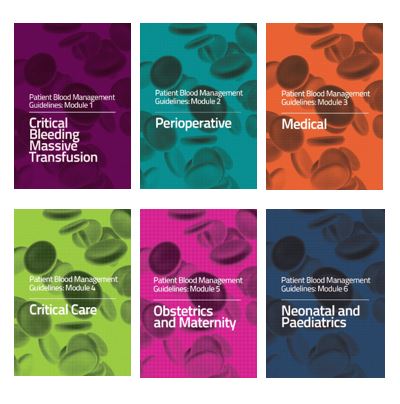
In 2008, the NBA established an Expert Working Group (EWG) to define the scope and structure of the PBM Guidelines. The EWG split the Guidelines into six modules, with each module aimed at assisting and guiding healthcare professionals in making clinical decisions when managing the following specific patient populations:
Together, these 6 modules were to replace the 2001 NHMRC/ Australasian Society of Blood Transfusion (ASBT) Clinical practice guidelines on the use of blood components.
The EWG developed a set of generic research questions that were investigated for each module, as well as specific research questions relevant to each module's patient population.
The NBA established six Clinical/ Consumer Reference Groups (CRGs) that included multi-disciplinary membership with representation from clinical colleges, societies and consumer groups. CRGs provided expert oversight to the evidence review process and the translation of evidence into clinical guidance for each patient population.
The EWG and CRGs together included 13 members who had been supported by NHMRC grant funding prior to their work on the PBM Guidelines. Collectively, these members received:
A multilevel management framework was established by the NBA to coordinate the development of the Guidelines, consisting of:
To answer the research questions, comprehensive search strategies were designed and systematic reviews of the scientific literature were undertaken. The body of evidence was consolidated into evidence statements and rated in accordance with NHMRC's FORM methodology, which consisted of five components (evidence base, consistency, clinical impact, generalisability and applicability) which were used by guideline developers to structure their decisions.
All six modules were developed in accordance with NHMRC's procedures and requirements for meeting the NHMRC standard for clinical practice guidelines.
Once completed, the six modules included 52 recommendations plus 198 points of advice based on expert clinical consensus.
Recommendations covered such topics as:
Points of expert opinion concerned topics such as:
NHMRC approved all modules, meaning NHMRC was satisfied that the modules were based on systematic identification and synthesis of the best available scientific evidence and included clear recommendations for health professionals. The modules were released progressively from 2011 to 2016 and were endorsed by many Australian, Australasian and New Zealand clinical colleges and societies.
Within Australia and also internationally, there has been a paradigm shift toward a focus on PBM, but uptake of PBM principles by the clinical community is variable. Understanding when and how blood and blood products are used has been critical to achieving improvement. The conduct of high quality research remains crucial to provide a strong evidence base to drive uptake of PBM principles.
Since the launch of the PBM Guidelines and accompanying implementation strategy, Australia has seen a significant reduction in the use of red blood cells. The demand for red blood cells from 2012–13 to 2017–18 fell by over 23% and was accompanied by improvements in patient outcomes and financial savings of $107.1 million.
The implementation of the National Safety and Quality Health Service (NSQHS) Standards (which include a dedicated hospital accreditation standard for Blood and Blood Products and the revised Blood Management Standard) has also contributed to this decline in the use of red blood cells.
This reduction in use would not have occurred however, without the concerted effort of jurisdictional programs and clinical PBM champions and a willingness by healthcare professionals to adopt a patient focus rather than a product focus and to use blood and blood products more appropriately and safely.
Significant scope remains for consolidation of gains already made and further penetration of PBM in clinical practice.
The PBM Guidelines are currently under review. While the review is underway, the original modules remain in place to guide practice.
| Year | Activity |
|---|---|
| 1987 | Project Grant (Bowden) |
| 1988 | Postgraduate Scholarship (Lindeman) |
| 1990 | Project Grant (Bowden), Postgraduate Scholarship (Olynyk) |
| 1994 | Project Grant (Bowden) |
| 1995 | Project Grant (Lindeman) |
| 1996 | Postgraduate Scholarship (Shields) |
| 1997 | Project Grant (Lindeman) |
| 1999 | Postgraduate Scholarship (Gruen) |
| 2001 | 2001 NHMRC/ASBT Guidelines |
| 2002 | Development Grant (Olynyk) |
| 2003 | Project Grants (Olynyk) |
| 2004 | Project Grants (Lindeman, Olynyk) |
| 2006 | Project Grant (Olynyk) |
| 2007 | Project Grants (Olynyk, Permezel) |
| 2008 | Grants (Gruen, Olynyk, McLintock) |
| 2009 | Grants (French, Lindeman, Olynyk, Permezel, Stark) |
| 2010 | Project Grants (Olynyk), Centres of Research Excellence (Shields, Marriott) |
| 2011 | Module 1 published, Project Grants (Liley, Olynyk) |
| 2012 | Modules (2,3,4) published, Grants (French, Gardener, McLintock) |
| 2013 | Centre of Research Excellence (Marriott) |
| 2014 | Grants (French, Gardener, McLintock, Marriott) |
| 2015 | Module 5 published, Grants (Thomson, Marriott) |
| 2016 | Module 6 published |
Research capacity and robust research systems are essential for generating and applying evidence in health advice, policy and practice.
The development of the Guidelines benefited from NHMRC's investment in building research capacity through its grant support to a number of members of the steering Committee, EWG and CRG (shown underlined).
Chairs: Ms Stephanie Gunn, Dr Alison Turner
A/Prof Lilon Bandler, Dr Heather Buchan, Ms Karen Carey, Ms Cathy Clutton, Ms Vesna Cvjeticanin, Dr James Daly, Mr Ken Davis, Prof Henry Ekert, Dr Steve Flecknoe-Brown, Ms Trudi Gallagher, Dr Kerry Gunn, Ms Susan Ireland, Professor James Isbister, Ms Kathy Meleady, Ms Bronwyn Pearce, Dr Beverley Rowbotham, Dr Ben Saxon, Dr Rashmi Sharma, Ms Tracey Spigiel, Dr Amanda Thomson, Prof Simon Towler.
Co-Chairs: A/Prof Craig French, Dr Amanda Thomson
A/Prof Donald Bowden, A/Prof Mark Dean, Mr Shannon Farmer, Dr Chris Hogan, Ms Janine Learmont, A/Prof Helen Liley, Dr Robert Lindeman, A/Prof Larry McNicol, Prof John Olynyk, Prof Michael Permezel, Dr Kathryn Robinson, Dr Helen Savoia, Dr Richard Seigne, Dr Philip Truskett, Dr John Vinen.
The National Blood Authority (NBA) was established in 2003. It is a statutory agency within the Australian Government health portfolio that manages and coordinates arrangements for the supply of blood and blood products and services on behalf of all Australian governments. Funding, secretariat and project management for the PBM Guidelines were provided by the NBA.
The development of the Guidelines' recommendations was not influenced by the views or interests of the NBA.
This case study was developed in partnership with the National Blood Authority, Australia.
The information and images from which impact case studies are produced may be obtained from a number of sources including our case study partner, NHMRC's internal records and publicly available materials.
The sources consulted for this case study were the PBM Guideline modules, as shown and described in the following:
Visit the National Blood Authority's website for the Patient Blood Management Guidelines.
