We're changing the way Sapphire looks
Same platform, new visual identity. Learn more: Sapphire is becoming NHMRC Grant Management System.
We're changing the way Sapphire looks
Same platform, new visual identity. Learn more: Sapphire is becoming NHMRC Grant Management System.
Pharmaxis Ltd is an Australian pharmaceutical research company established in 1998. It listed on the Australian Securities Exchange (ASX) in 2003. The business focuses on new therapies to treat inflammation and fibrosis with a portfolio of products at various stages of development and approval. With origins in clinical research, this Australian-owned start up successfully competes in an international market.
A landscape format version of this case study is available as a PDF from the Downloads section below.
The Pharmaxis story began in the 1990s when Drs Brett Charlton and William Cowden met at the John Curtin School of Medical Research (JCSMR) at the Australian National University (ANU). They cofounded Pharmaxis (originally named Praxis Inc.) in 1998 to commercialise a group of compounds (patented by ANU) with the potential to treat inflammatory and other immune-mediated diseases.
This initial intellectual property (IP) licence attracted venture capital funding and enabled Pharmaxis to license further patents from ANU and CSIRO. These early licences did not progress to commercial development. However, they created a momentum of activity and interest which, in 2001, allowed Pharmaxis to license IP from the (then) Central Sydney Area Health Service (CSAHS) on the potential of the dry sugar mannitol to diagnose asthma and reduce the symptoms of cystic fibrosis (CF). This patent was developed into Pharmaxis’ first products, Aridol® and Bronchitol®, in collaboration with Dr Sandra Anderson AM (University of Sydney) and her colleagues. (See separate NHMRC case study.)
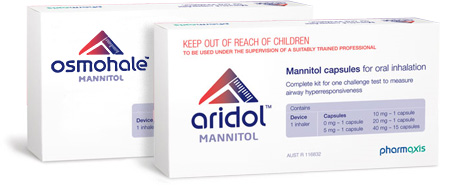
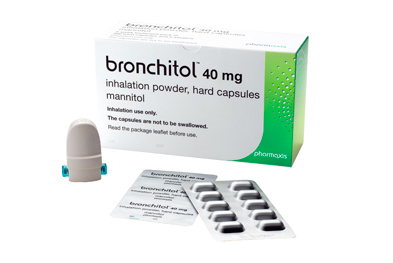
Dry mannitol powder has a number of uses. In Aridol it is used in aerosol form as a test to identify asthma and access its severity. In Bronchitol it assists people with cystic fibrosis to clear their airways of mucus.
NHMRC supports Drs Charlton and Cowden early in their careers. Pharmaxis also received Development Grants in association with other institutions.
The road to developing a fully viable company took many twists and turns. There were few venture capitalists (VCs) when Charlton and Cowden first established Pharmaxis. Their early suite of patent licences led them to Melbourne-based VC fund GBS Ventures in 1999. GBS commissioned Dr Alan Robertson, then a consultant, to report to them on the company. Based on his report, they committed the first seed funding. Charlton and Cowden hired Robertson as CEO to provide the company with much-needed business experience, and he helped kick-start the company’s rapid progression. Clinical trials progressed within 10 years, requiring several rounds of successful capital fund raising. Pharmaxis established its manufacturing facility in Sydney during this period.
Since bringing Aridol® and Bronchitol® to market, the company strengthened its drug discovery capability by hiring experienced international pharmaceutical executives. The company now focuses on developing drugs to Phase I or Phase II clinical trials, and then licensing these drugs to larger pharmaceutical companies. For example, in 2015, Pharmaxis licensed a drug to German-based Boehringer Ingelheim (BI), which BI is now trialling. Pharmaxis receives staged payments based on the success of the trials; to date, these have totalled $83 million.
Early research leads were not successful for Pharmaxis but the subsequent licensing of the mannitol patent from CSAHS ultimately led to the clinical trialling and commercial development of Aridol® and Bronchitol®.
Following the recruitment of Ian McDonald in 2005, Pharmaxis built a drug discovery program based on amine oxidase chemistry and now focuses on discovering drugs to treat inflammatory and fibrotic diseases such as the liver disease Non-Alcoholic Steatohepatitis (NASH), pulmonary fibrosis, kidney and liver fibrosis and cancer.
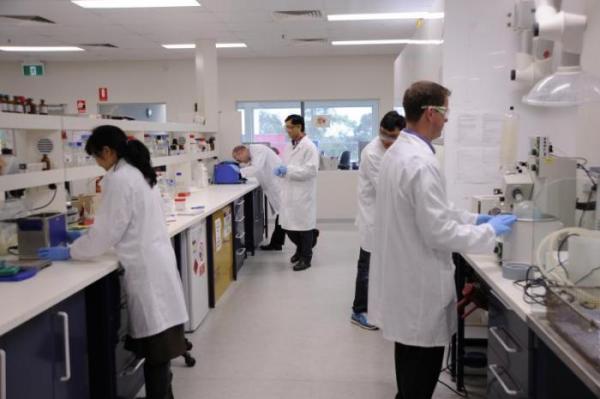
Since its foundations in 1998, Pharmaxis has achieved significant milestones for an Australian-owned company. It has:
| Date | Event |
|---|---|
| 1983 | NHMRC Scholarship |
| 1987 | NHMRC Fellowship |
| 1991 | NHMRC TCR Grant |
| 1994 | NHMRC Project Grant |
| 1995 | Charlton and Cowden meet at JCSMR |
| 1998 | NHMRC International Collaborations for Diabetes Research Grant |
| 1998 | Pharmaxis Ltd Eestablished |
| 1999 | GBS Ventures Funding |
| 2000 | AusIndustry Grant |
| 2001 | Biotechnology Innovation Fund Grant |
| 2001 | GBS Ventures Funding |
| 2003 | AusIndustry Grant |
| 2003 | ASX listing |
| 2005 | NHMRC Grant |
| 2006 | Therapeutical Goods Association (TGA) Approval (Aridol) |
| 2007 | ARC Grant |
| 2009 | Orphan Drug Designation (Bronchitol) |
| 2010 | Food and Drug Administration Approval (Aridol) |
| 2011 | TGA Approval (Bronchitol) |
| 2012 | European Medicines Agency Approval (Bronchitol in CF) |
| 2012 | PBS Listing (Bronchitol) |
| 2013 | ARC Grants |
| 2015 | Boehringer acquires BI 1467335 |
| 2016 | NHMRC Grant |
| 2017 | NHMRC Grant |
Dr Charlton is co-founder and Medical Director of Pharmaxis Ltd. He helped to attract funding from a range of public and private investors to develop Aridol® and Bronchitol®. Dr Charlton has been an NHMRC Postdoctoral Fellow at the WEHI and visiting clinician at Royal Melbourne Hospital working on diabetes and autoimmunity. He was a Founding Medical Director of the National Health Sciences Centre in Canberra. In 1995 he was awarded the Aza/Lilly Fellowship from Diabetes Australia.
Dr Cowden is co-founder, and was Chief Scientific Officer (until 2008), of Pharmaxis Ltd. He has spent over 20 years developing new therapeutic compounds for the treatments of cancer, infectious disease, and inflammatory diseases. Dr Cowden has held senior research positions at the JCSMR, Peptide Technology Ltd
(Peptech), and consulting scientist to Anutech. He received a PhD in Medical Chemistry from the University of Queensland in 1979. He is the coinventor on 12 patents and author of over 130 scientific papers.
Dr Robertson served as CEO of Pharmaxis Ltd from 1999 - 2013. Prior to this, he held senior product development roles at Wellcome PLC, Faulding Group and Amrad Pty Ltd. Dr Robertson has assisted in the establishment of two start-up companies, Promics Pty Ltd and Pharmaxis Ltd. He is the co-inventor of 18 patents and author of more than 35 scientific papers. He is also the inventor of the migraine therapeutic Zomig. Dr Robertson holds a BSc and a PhD in Synthetic Organic Chemistry from the University of Glasgow.
Mr Phillips joined Pharmaxis Ltd in 2003, and was appointed CEO and a director in 2013. He previously held the positions of Commercial Director and Chief Operating Officer. Mr Phillips has more than 30 years of management experience in the pharmaceutical and healthcare industry in Europe, Asia and Australia, including at Ciba Geigy (Hungary), and Novartis Australia. He holds a B Pharm from Nottingham University, UK, and an MBA from Henley Management College. Mr Phillips is a Graduate Member of the Australian Institute of Company Directors.
Dr McDonald was the Chief Technical Officer at Pharmaxis Ltf from 2005 - 2012. He has over 25 years of international experience in managing drug discovery and design teams in Europe and USA, including at Structural GenomiX, Structural Bioinformatics, SIBIA Neurosciences and Merrell Dow. Under his leadership at Pharmaxis Ltd, six compounds have been developed and evaluated in clinical trials. Dr McDonald was awarded his PhD in Organic Chemistry from the University of WA and has co-authored over 75 peer-reviewed manuscripts and book chapters, and is an inventor on 39 issued US patents.
Dr Jarolimek joined Pharmaxis Ltd in 2010 as Manager, In Vitro Pharmacology, and was appointed Head of Drug Discovery in 2012. He has more than 20 years' experience in pharmaceutical drug discovery and has published more than 20 peer-reviewed articles. Prior to joining Pharmaxis Ltd, Dr Jarolimek worked at GlaxoSmithKline, Italy, and Merck, Sharp and Dohme, England. He holds a PhD in Pharmacy from the University of Saarbrücken, Germany. In 1997, he became Assistant Professor in Physiology at the University of Heidelberg, Germany.