Neurotransmitters are small molecules that enable communication from nerve cells to other cells, including muscle, glands and other neurons throughout the body. They are essential for processes such as movement, cognition, digestion and cardiovascular control. NHMRC‑funded researchers discovered an entirely new type of neurotransmitter, leading to the development of a new area of research. Their work has contributed to the development of new drugs that can prevent heart attacks and stroke, treat chronic cough and relieve dry eye disease.
Origin
Neurons are electro-chemical cells that enable the brain, spinal cord and nervous system to process information. Information is transmitted electrically along the processes of each neuron but chemically in between them. These ‘chemicals’ are called neurotransmitters, which are organic molecules typically made up of a few dozen atoms.
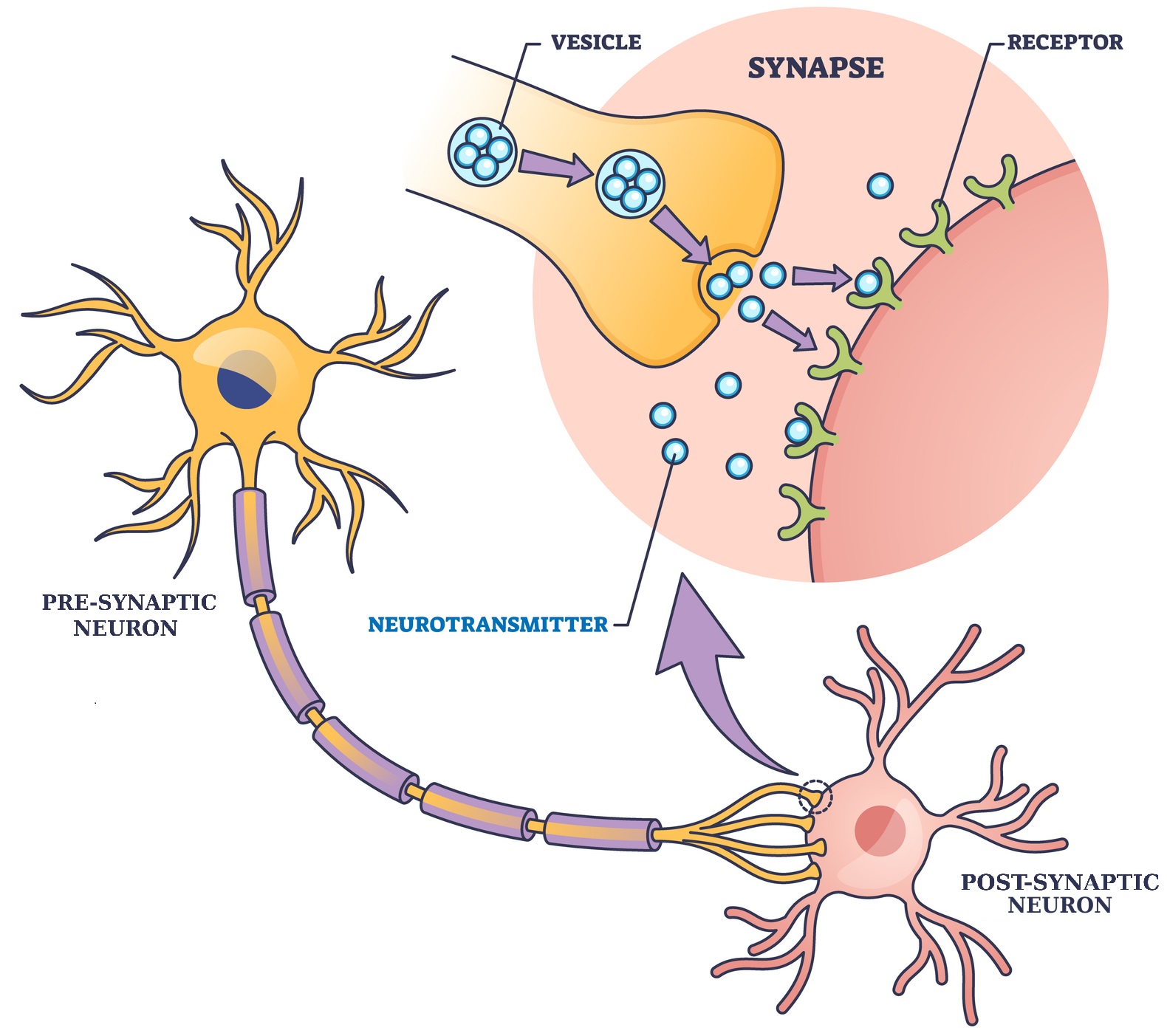
At present, over 100 different neurotransmitter molecules have been identified, however it was not until 1929 that the first neurotransmitter – the molecule acetylcholine (ACh) – was isolated from animal tissues. Over the course of the next half century or so further molecules – noradrenaline, dopamine, serotonin, GABA, glycine and glutamate – were also identified as neurotransmitters.
Notably, the discovery of glycine as a neurotransmitter was largely due to the work of Australian scientist David Curtis, a researcher at the John Curtin School of Medical Research at the Australian National University. Curtis was a colleague of Nobel Laureate John Eccles, and their work has previously been described in the A foundation for neuroscience Impact Case Study.
Some neurotransmitters, such as glutamate, are excitatory, which means they make the next nerve cell more likely to send a signal. Neurotransmitters such as GABA and glycine are inhibitory, which means they make the next nerve cell less likely to send a signal and help reduce activity in the nervous system. Other neurotransmitters, including dopamine, serotonin, noradrenaline and acetylcholine, do not simply switch activity on or off. Instead, they adjust or fine‑tune how signals are sent, depending on the type of receptor they act on and the situation in the body.
Up to the mid‑20th century, neuroscience research was focused on only a subset of transmitter actions, particularly those that were clearly excitatory or inhibitory and involving very short (millisecond) timescales. Neuroscientists also assumed that individual neurons would produce only one type of transmitter and that this would lead to only one type of modulatory effect. This conceptual framework had worked extremely well for reflexes, sensory processing, motor control and rapid information transfer, however it struggled to explain a number of other well-known nervous system phenomena. These included that some neural changes:
- developed over seconds to minutes rather than milliseconds
- varied depending upon bodily states such as stress, hunger and time of day
- themselves exerted diffuse effects across the nervous system.
In summary, classical neurotransmitter theory had explained rapid signal transmission very well but slower post-junctional effects rather poorly.
After completing his BSc in 1953, UK neuroscientist Geoffrey Burnstock worked with colleagues at University College, London (UCL) on strips of smooth muscle kept alive in laboratory tissue baths containing warm, oxygenated salt solution. They electrically stimulated the nerves supplying these tissues and directly recorded the resulting electrical signals from the muscle cells, while at the same time measuring how strongly the muscle contracted. They added ACh and noradrenaline to the tissue baths to see how the muscles responded. By doing this, they were able to link nerve stimulation to electrical changes in the muscle and to the physical contraction that followed.
Their work largely confirmed existing ideas about how nerves communicate with muscles, however it also gave Burnstock the experimental tools and experience needed to recognise nerve driven responses that could not be explained by classical neurotransmitter theory.
Investment
Following Burnstock’s arrival from London at the University of Melbourne in 1959, he began to receive support from NHMRC project grants to undertake further neuroscience research. Burnstock worked closely with a number of other NHMRC-funded neuroscientists including Mollie Holman, Marcello Costa, John Furness and Max Bennett.
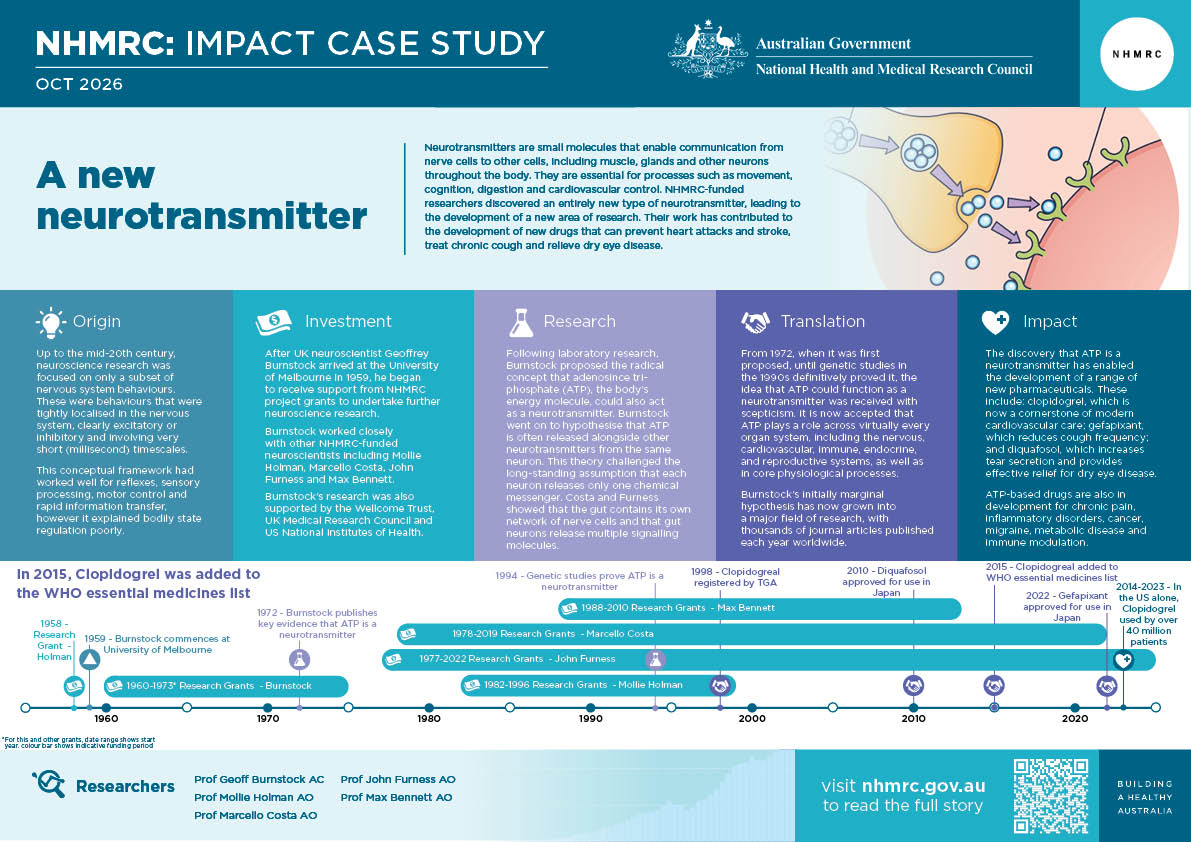
The PDF poster version of this case study includes a graphical timeline showing NHMRC grants provided and other events described in the case study.
Research
While working at the University of Melbourne in the Departments of Zoology and Physiology, Burnstock, electrophysiologist Mollie Holman and colleagues Max Bennett, Graeme Campbell and David Satchell undertook experiments using strips of intestinal smooth muscle. They electrically stimulated the nerves that innervated the muscle and recorded both muscle contraction and rapid electrical responses. Intracellular recordings showed fast inhibitory electrical signals that occurred with the timing expected of direct neurotransmission.
At this time, it was generally believed that for transmission to visceral tissues, including the intestine, there were only two neurotransmitters, acetylcholine and noradrenaline, being released. However, when the researchers blocked the actions of ACh and noradrenaline they found that nerve‑evoked muscle relaxation persisted, though it disappeared when nerve activity itself was entirely blocked. These findings demonstrated that the gut nerves were releasing an unknown, ‘non‑adrenergic, non‑cholinergic’ (NANC) inhibitory signal that could not be explained by the existing theory.1
Burnstock and his collaborators then focused on identifying the chemical responsible for this signalling. They tested simple, well‑characterised molecules already present in nerve terminals, including adenosine triphosphate (ATP). ATP is the main energy‑carrying molecule in living cells and at that time it was not thought to play any role in neurotransmission.
Nonetheless, when the researchers applied ATP directly to isolated gut muscle it produced electrical and mechanical responses closely matching those evoked by NANC nerve stimulation. They showed that ATP‑evoked and nerve‑evoked responses shared the same timing and other characteristics and that an ATP-like chemical was released when the nerves were stimulated.
ATP is, biochemically, a member of a class of nitrogen‑containing organic molecules called purines. Burnstock proposed the radical concept that ATP could act as a neurotransmitter, introducing the concept of ‘purinergic signalling’.2 Up to the time of Burnstock’s research the collection of known neurotransmitters did not include any purines. Moreover, there were no known receptors for purines within neurons or the cells they innervate. Furthermore, ATP and related purines are present in all cells at high concentrations while (at that time) neurotransmitters were assumed to be specialised signalling molecules existing in only vesicles within neurons and nerve terminals.
Burnstock went on to hypothesise that ATP is often released alongside classical neurotransmitters from the same neuron. This theory challenged the long‑standing assumption that each neuron releases only one chemical messenger. Some of the earliest evidence in support of this idea of co‑transmission was provided by Marcello Costa and John Furness, both members of Burnstock’s team, who used the term ‘plurichemical transmission’ to indicate that multiple transmitters could be released.3
Working first at the University of Melbourne and later at Flinders University, Costa and Furness showed that the gut contains its own tightly packed network of nerve cells (enteric neurons). They showed that these cells are organised into linked pathways that work together to control how the gut functions. They also showed that gut neurons commonly release multiple signalling molecules, including ATP.
Translation
At the time it was first proposed in 1972, the idea that ATP could function as a neurotransmitter was received with scepticism. Researchers questioned whether ATP could be released in a regulated manner or achieve the specificity expected of neurotransmission. In 1994, however, researchers were able to isolate and copy the genes for purinergic receptors and express them in experimental cells.4
When these cloned receptors were introduced into cells that would not normally respond to ATP, adding ATP now produced clear and predictable electrical or signalling responses. This demonstrated that ATP acts through dedicated receptors in the same way as established neurotransmitters such as ACh and noradrenaline. By providing direct molecular evidence for ATP specific receptors, cloning confirmed purinergic signalling as a genuine neurotransmitter system.4
The discovery of purinergic neurotransmission has transformed understanding of cellular communication. ATP is now routinely included alongside ACh, dopamine and other classical neurotransmitters in neuroscience textbooks, and the concept of co‑transmission – where neurons release multiple signalling molecules – is well established.
It is now accepted that purinergic signalling plays a role across virtually every organ system, including the nervous, cardiovascular, immune, endocrine, and reproductive systems, as well as in core physiological processes. This knowledge has significantly deepened scientific understanding of how these systems function in both health and disease.
Burnstock’s initially marginal hypothesis has now grown into a major field of research. Following initial publications communicating the hypothesis in 1970 and 1972, investigation into purinergic signalling expanded rapidly with thousands of journal articles now published each year worldwide.5 Dedicated journals and international conferences now focus on purinergic biology, including Purinergic Signalling, which Burnstock founded and served as editor‑in‑chief.
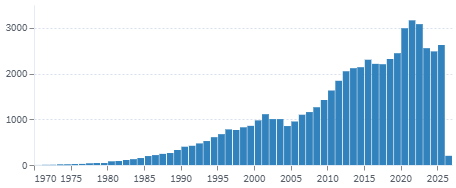
from zero to thousands each year. Image source: lens.org
Indicative of the influence of his ideas, Burnstock was among the most highly cited scientists of his era; between 1994 and 2004, he was ranked the most cited researcher in pharmacology and toxicology. His 1972 Pharmacological Reviews article is widely regarded as a foundational or landmark paper in neuropharmacology.6
Outcomes and impacts
The discovery of purinergic signalling has led to major, real‑world health benefits across multiple medical fields. Most notably, it underpins the development of a range of new pharmaceuticals targeted at a particular type of purinergic receptor called a ‘P2Y receptor’.7
One example of such a pharmaceutical is clopidogrel, which was first registered by Australia’s Therapeutic Goods Administration (TGA) in 1998 and is now a cornerstone of modern cardiovascular care.8 Clopidogrel is prescribed worldwide for the prevention of recurrent heart attacks and strokes9 and is included on the World Health Organization’s Model List of Essential Medicines.10 Since 2014 and in the United States, clopidogrel has been (on average) the 37th most frequently prescribed medication, taken by around four million patients each year.11
For the management of chronic eye disease, diquafosol, first approved in Japan in 2010, mimics the actions of ATP on cells lining the surface of the eye, increasing tear and mucin secretion and providing effective relief for dry eye disease, particularly in patients who do not respond adequately to artificial tears.12 13 Diquafosol has been used routinely in ophthalmic practice for more than a decade14, with multiple reformulations introduced.15
Gefapixant, approved in Japan in 2022, reduces cough frequency by blocking ATP‑mediated sensory nerve activation. This is the first targeted pharmacological treatment for refractory or unexplained chronic cough, a condition for which no specific therapies previously existed.16 For patients with a disabling, long‑standing condition that was previously untreatable, gefapixant offers meaningful improvements in quality of life.17
Looking ahead, the health impact of purinergic signalling is likely to grow. Drugs targeting purinergic receptors are in development for chronic pain, inflammatory disorders, cancer, migraine, metabolic disease, and immune modulation. Early evidence suggests these approaches may address conditions where existing therapies are limited or ineffective, potentially reducing symptom burden, improving function, and expanding treatment choices for patients.
Researchers
Professor Geoffrey Burnstock AC
Geoffrey Burnstock (1929–2020) completed a PhD at University College London in 1957 and moved to Australia and the University of Melbourne in 1959. He became Professor and then Chair of Zoology (1964–1975). In 1975, he returned to England as Head of the Department of Anatomy and Developmental Biology at UCL. Burnstock received numerous accolades, including Fellowship in the Australian Academy of Science (1971) and the Royal Society, UK (1986). In 1998, he became the inaugural President of the International Society for Autonomic Neuroscience and in 2000 he was awarded the Royal Society’s Royal Medal for his contributions to biology. In 2018, he was appointed a Companion of the Order of Australia (AC) for his service to medical science.
Professor Mollie Holman AO
Mollie Elizabeth Holman (1930–2012) completed a Bachelor of Science (1952) and a Master of Science (1955) at the University of Melbourne and a PhD (1957) at the University of Oxford. Holman held academic appointments at the University of Melbourne before joining Monash University in 1963, where she progressed from Senior Lecturer to Reader to Professor of Physiology (1970-1996). Holman was elected a Fellow of the Australian Academy of Science in 1970 and was awarded the ANZAAS Medal in 1985. In 1998, Holman was appointed an Officer of the Order of Australia ‘For service to scientific research, particularly relating to the autonomic nervous system and the control of smooth muscle, and to education and university administration’.
Professor Marcello Costa AO
Marcello Costa (1940–2024) held academic appointments at Flinders University spanning several decades. He was appointed Lecturer and later Reader in Human Physiology between 1975 and 1985, before holding a Personal Chair in Neurophysiology in the School of Medicine from 1985 to 2012. Costa was a founding member of the Australasian Neuroscience Society in 1980, served as its President from 1994 to 1995, and was elected a Life Member in 2010. He was elected a Fellow of the Australian Academy of Science in 1989. In 2001, Costa was awarded the Centenary Medal and in 2020 was appointed an Officer of the Order of Australia ‘For distinguished service to higher education, and to medical research, in the field of neurophysiology, and to professional scientific bodies’.
Professor John Furness AO
John Barton Furness graduated in physics and mathematics and completed his doctoral training in Australia. Furness has held academic appointments at the University of Melbourne and later at Flinders University, where he became Professor of Anatomy and Head of Department.
Furness is recipient of the: Janssen Research Award, 1993; Distinguished Research Prize, Gastroenterological Society of Australia, 1994; Australian Physiological and Pharmacological Society Lecture and Medal, 1995; Grossman Lecturer, Cambridge, 1995; Horace Davenport Award of the American Physiological Society, 1997; Fellowship and Gold medal Academy of Science of Bologna (L'accademia delle scienze dell'istituto di Bologna) founded 1690; Distinguished Visiting Research Scientist of the Japan Society for the Promotion of Science 2011; Wingate Lecturer, University of London, 2014; Honorary Life Member, Physiological Society (Britain) 2019; and other national and international awards.
In 2001, Furness was awarded the Centenary Medal, and in 2024 was appointed an Officer of the Order of Australia ‘For distinguished service to medical research in the field of autonomic neuroscience and neurogastroenterology.’
Professor Max Bennett AO
Maxwell Richard Bennett completed undergraduate studies in electrical engineering at the University of Melbourne (1963), then an MSc (1965) and a PhD (1967). He took up an academic appointment in the Department of Physiology at the University of Sydney in 1969 and was appointed to a personal chair in physiology in 1980, later becoming Professor of Neuroscience at the University of Sydney. He served as Founding Director of the university’s Brain and Mind Research Institute from 2003.
In 2001, Bennett was awarded the Centenary Medal and was appointed an Officer of the Order of Australia ‘For service to the biological sciences, particularly in the field of neuroscience and as a major contributor to the establishment of organisations aimed at furthering interdisciplinary research in this field, and to education.’
Other Australian researchers
Dr David Geoffrey Satchell (University of Melbourne), Professor Tim Cowen, Professor Ivana Novak (University of Queensland), Dr Pamela Milner, Professor Adam Sillito and Dr Jim Curry.
International collaborators
Burnstock also worked with many international collaborators including Professor Alexei Verkhratsky (University of Manchester), Professor Andrzej Loesch (UCL), Professor Charles Kennedy (University of Strathclyde), Professor Philippe Bodin (Université de Rouen Normandie), Professor Brian F. King (University College London), Professor Maria P. Abbracchio (University of Milan) and Professor Vera Ralevic (University of Nottingham).
Partners
This case study was developed with input from Professor John Furness AO at the University of Melbourne.
Disclaimer
Under NHMRC’s Funding Agreement, Administering Institutions must comply, and require their Participating Institutions, Research Activities and applications to comply with relevant legislation. At the time of writing, relevant legislation governing the use of animals for research includes state and territory animal welfare legislation. NHMRC also requires compliance with NHMRC approved Standards and Guidelines and any applicable NHMRC policies. At the time of writing, and with respect to animals, these include the:
- Australian Code for the Responsible Conduct of Research (2018)
- Australian code for the care and use of animals for scientific purposes 8th edition (2013, updated 2021)
- Best practice methodology in the use of animals for scientific purposes (2017)
- Principles and guidelines on the care and use of non-human primates for scientific purposes (2016)
- A guide to the care and use of Australian native mammals in research and teaching (2014).
Ethical, scientific, veterinary and medical standards and practices related to animal research change over time. NHMRC-funded research activities that occurred before the present time were subject to the legislation and NHMRC’s Standards, Guidelines and policies in force at the time that they occurred.
References
The information and images from which Impact Case Studies are produced may be obtained from a number of sources including our case study partner, NHMRC’s internal records and publicly available materials. Key sources of information consulted for this case study include:
1Burnstock G. Evidence that adenosine triphosphate or a related nucleotide is the transmitter substance released by non‑adrenergic inhibitory nerves in the gut. Br J Pharmacol. 1970;40(4):668–688
2Burnstock G. Purinergic nerves. Pharmacol Rev. 1972;24(3):509–581
3Furness, J.B., Morris, J.L., Gibbins, I.L. & Costa, M.:Chemical coding of neurons and plurichemical transmission. Ann.Rev. Pharmacol.Toxicol.29:289-306 (1989)
4Valera S, Hussy N, Evans RJ, Adami N, North RA, Surprenant A, Buell G. A new class of ligand‑gated ion channel defined by P2X receptor for extracellular ATP. Nature. 1994;371(6497):516–519
5Verkhratsky A, Zimmermann H, Abbracchio MP, Illes P, Di Virgilio F. In Memoriam Geoffrey Burnstock: Creator of purinergic signaling. Function. 2020;1(1):zqaa006
6Garfield E. Citation classic: Burnstock G. Purinergic nerves. Pharmacol Rev. 1972;24:509‑81. Current Contents (Life Sciences). 1985;3
7Ford AP, Dillon MP, Kitt MM, Gever JR. The discovery and development of gefapixant. Auton Neurosci. 2021;235:102859
8Yusuf S, Zhao F, Mehta SR, Chrolavicius S, Tognoni G, Fox KK; CURE Trial Investigators. Effects of clopidogrel in addition to aspirin in patients with acute coronary syndromes without ST segment elevation. N Engl J Med. 2001;345(7):494 502
9Drugs.com. Clopidogrel: uses and indications. ASHP Drug Monograph. Updated 2025
10Patel A, Vidula M, Kishore SP, Vedanthan R, Huffman MD. Building the case for clopidogrel as a World Health Organization essential medicine. Circ Cardiovasc Qual Outcomes. 2015;8(4):447 451
11ClinCalc DrugStats Database. Clopidogrel: U.S. drug utilization statistics, 2023
12Koh S. Clinical utility of 3% diquafosol ophthalmic solution in the treatment of dry eyes. Clin Ophthalmol. 2015;9:865–872
13Lau OC, Samarawickrama C, Skalicky SE. P2Y₂ receptor agonists for the treatment of dry eye disease: a review. Clin Ophthalmol. 2014;8:327–334
14Watanabe H. Medical treatment for dry eye in Japan. Invest Ophthalmol Vis Sci. 2018;59:DES116–DES120
15Arita R, Fukuoka S, Kaido M. Tolerability of long acting diquafosol ophthalmic solution on tear film and meibomian gland findings in a real clinical scenario. PLoS One. 2024;19(9):e0305020
16Barrie R. FDA rejects MSD’s gefapixant for chronic cough. Pharm Technol. 2023 Dec 22
17Kum E, Patel M, Diab N, et al. Efficacy and tolerability of gefapixant for treatment of refractory or unexplained chronic cough: a systematic review and dose–response meta analysis. JAMA. 2023;330(14):1359 1369