We're changing the way Sapphire looks
Same platform, new visual identity. Learn more: Sapphire is becoming NHMRC Grant Management System.
We're changing the way Sapphire looks
Same platform, new visual identity. Learn more: Sapphire is becoming NHMRC Grant Management System.
Iodine is an essential nutrient required for normal brain development and growth. NHMRC-funded researchers established that iodine deficiency during pregnancy causes irreversible brain damage in children and demonstrated that this damage can be prevented through supplementation. Their work underpinned global public health measures, contributing to the large-scale reduction of iodine deficiency disorders in many countries and protecting millions of children from preventable intellectual disability.
Since ancient times and throughout the world, a cluster of health conditions had been observed among people living inland, in mountainous and high rainfall regions such as the Alps in Europe, Himalayas in India, Appalachia in the United States and in the Daliangshan Mountain region of Sichuan Province, China. These health conditions included goitre (an abnormal enlargement of the thyroid gland causing swelling in the neck) and severe developmental impairment characterised by stunted growth, hearing and speech impairment, and intellectual disability, historically referred to as ‘cretinism’.
During the 1800s, and following the discovery of iodine in seaweed, researchers recognised that iodine was likely the active ingredient in traditional seaweed remedies for goitre. Iodine deficiency in soil and water was proposed as the cause of endemic goitre, and iodine was identified as a normal constituent of the thyroid gland.1,2 Starting in the 1920s, iodine supplementation programs began to be implemented in various parts of the world.
In 1953, an article in the Medical Journal of Australia proposed that while ‘Endemic goitre is one of the most widespread and serious food deficiency issues in Australia today’, it was also one of the easiest of the food deficiency diseases to prevent.3 Superficially, it seemed as if the problem of goitre was no longer a problem for science but only for public health policy.
However, the relationship between iodine deficiency and developmental impairment was far from being understood. It was not known why some populations with endemic goitre experienced high rates of hearing and speech impairment, impaired growth and intellectual disability while others did not, nor whether iodine deficiency was the primary cause of these conditions. As one commentator described the situation with developmental impairment: ‘Geographically, it has been found wherever goitre is highly endemic . . . [but] the clinical picture is so varied that its existence as an aetiological entity is doubtful’.4
These uncertainties meant that governments, faced with scarce resources and unable to define the true public health significance of iodine deficiency, were also unable to build a compelling case for large-scale prevention programs. For this situation to change, new knowledge was urgently needed.
NHMRC supported a program of endocrine and thyroid research led by Basil Hetzel and colleagues at the University of Adelaide and associated institutions. Key researchers included John Charnock, Brian Good, Merrilyn Wellby, Michael Hoffmann, Ian Buttfield and Evelyn Mason. NHMRC also supported research on monitoring iodine deficiency disorders undertaken by a team at Westmead Hospital which included Creswell Eastman, Stephen Boyages, Glen Maberly and Mu Li.
Additional support for the impacts described in this case study was provided by CSIRO and international collaborators.
NHMRC also played a role in public health measures relating to goitre and supplementation in Australia.
In Australia, goitre was raised as an issue within the 1925 report of the Royal Commission on Health.5 Then, in 1948 and at the 26th meeting of NHMRC’s Council, a report was presented on the results of an Adelaide Hills Children’s Health Survey. The report stated that the Adelaide Hills was an endemic goitre area, that goitre was a preventable condition of major public health importance, and that measures should be taken to prevent the condition. At this same meeting Council also noted that the Australian Government had approved the expenditure of £1,500 per annum for the distribution of iodised salt tablets free of charge in those areas in Australia where goitre was present.6,7
In 1952, the World Health Organisation (WHO) convened a meeting to review the problem of endemic goitre and recommended iodisation of all food salt in iodine deficient areas.3,8 Then, at its 35th Session in 1953, NHMRC’s Council heard evidence that many people either did not use iodised salt or used insufficient quantities, while tablet programs depended on sustained participation and administration. After reviewing international experience, Council resolved to recommend that Australian states permit bakers to use iodised salt in bread.9
At its 41st Session in 1956, Council considered the report of NHMRC’s Goitre Committee.10 The Committee considered that endemic goitre remained an important public health problem in Australia, it recognised iodine deficiency as the most widespread cause of endemic goitre and it reaffirmed evidence from international and Australian studies showing that increased iodine intake could prevent many cases.
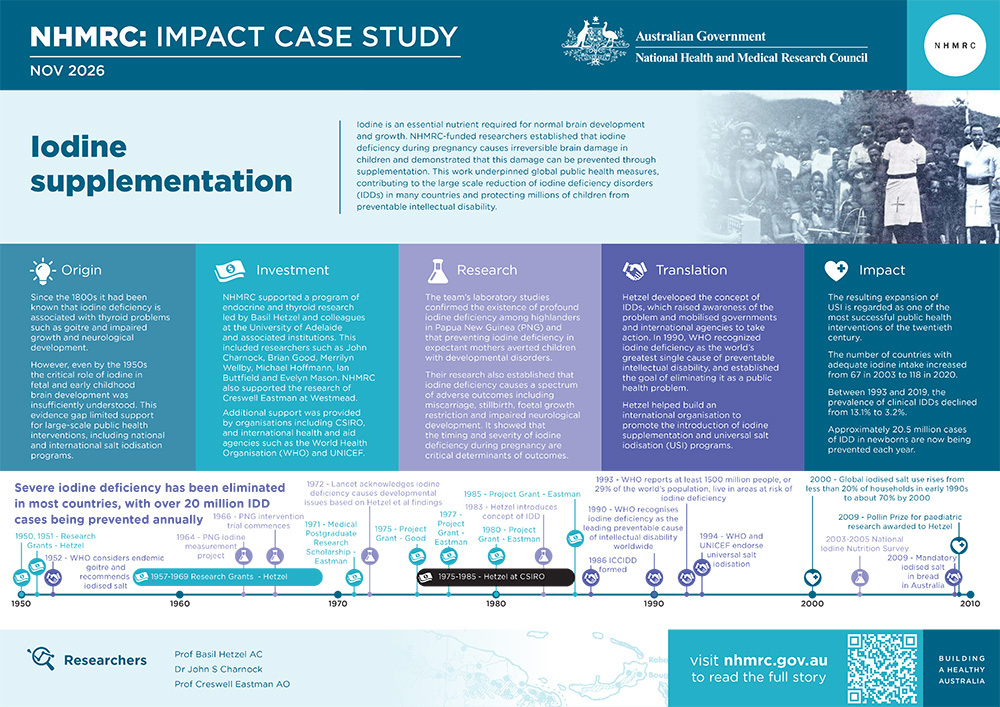
The PDF poster version of this case study includes a graphical timeline showing NHMRC grants provided and other events described in the case study.
Basil Hetzel and colleagues at the University of Adelaide had been undertaking NHMRC-funded research on thyroid physiology and endocrine regulation throughout the 1950s and early 1960s when, in October 1964, their assistance was requested by the Public Health Department in Papua New Guinea (PNG). The team there had been running a trial using a long-acting (lasting for 4 – 5 years) iodine oil injection to correct what was presumed to be iodine deficiency among PNG highlanders. However, the PNG Department had no laboratory available to measure whether iodine deficiency was actually present or whether the treatments were raising iodine levels. Such capabilities were, however, available at University of Adelaide.11
Hetzel’s laboratory studies confirmed the existence of profound iodine deficiency among the highlanders and as part of this process Hetzel observed entire villages where many adults had swollen necks (goitre) and numerous children suffered severe developmental delays and hearing and speech impediments.
In 1966 and as part of a collaborative project, Hetzel, Good, Hoffman, Buttfield and Mason conducted an intervention trial in which PNG families were alternately given injections of iodised oil or saline and followed for the next three years. The results were striking. In the placebo group, 26 children developed profound intellectual disability, deafness and motor impairment, whereas no comparable cases were observed in the iodine-supplemented group. The study provided conclusive evidence that preventing iodine deficiency during pregnancy protected foetal brain development, while maternal iodine deficiency in early pregnancy markedly increased the risk of serious and irreversible neurodevelopmental impairment.
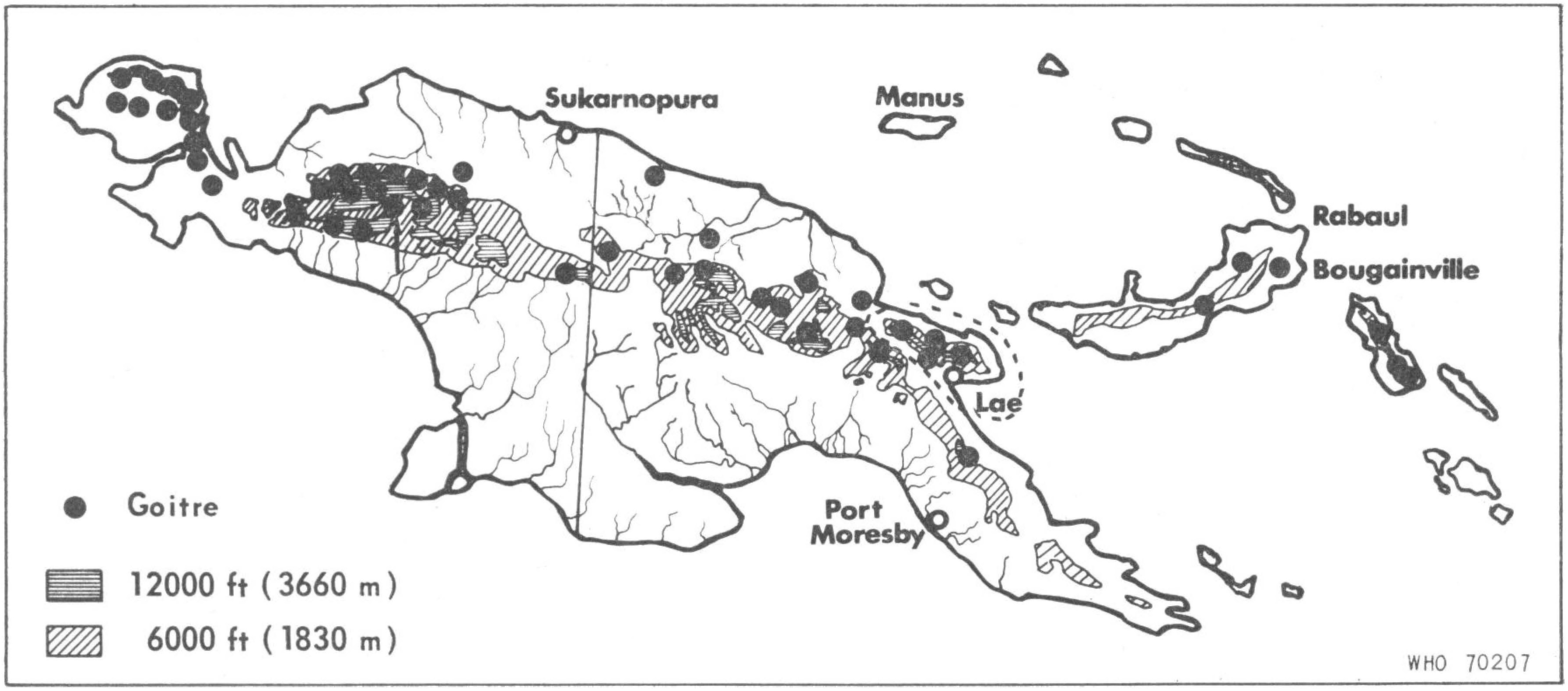
The work was reported to the International Thyroid Congress in Vienna in 1970 and an article reporting it was published in The Lancet.13 A subsequent Lancet editorial noted:
A plausible explanation of this puzzling situation [of the cause of endemic cretinism] is now at long last forthcoming. It arises from observations made in the Australian-administered territory of Papua-New Guinea and recorded last year in this journal. . . . The New Guinea team is to be congratulated not only on the illumination of one of the dark corners of medical aetiology but also for providing the means by which a significant load of misery may be lifted off human shoulders.4
As soon as the trial ended, Hetzel worked with the PNG government to launch a mass iodine supplementation campaign. Around 120,000 people in the highlands received iodised oil injections in the early 1970s, prioritizing women of childbearing age.14,15 This was followed by efforts to introduce iodised salt to the region. The team also undertook studies of iodine nutrition in Tasmania.16 A full account of the work was published by WHO. Team members also collaborated in projects with iodised oil being carried out in Mexico, Ecuador and the Philippines.
Following his appointment in 1975 as inaugural Chief of CSIRO's Division of Human Nutrition, Hetzel and his team undertook a series of studies to investigate the effects of iodine deficiency during pregnancy on foetal development in sheep and marmoset monkeys. These studies demonstrated that iodine deficiency caused a spectrum of adverse outcomes including miscarriage, stillbirth, congenital abnormalities, foetal growth restriction, goitre and impaired neurological development. The researchers showed that iodine-deficient offspring had reduced brain size together with persistent deficits in neurological function and learning, and established that these effects resulted from insufficient thyroid hormone exposure during critical stages of development in utero.
Reported in a series of papers published between 1979 and 1987, the findings provided the biological explanation for the observations made in PNG and demonstrated why populations with apparently similar levels of goitre could experience markedly different rates of hearing and speech impediments and intellectual disability. The work established that the timing and severity of iodine deficiency during pregnancy were critical determinants of cognitive and health outcomes.15
In a landmark 1983 Lancet paper, Hetzel proposed the concept of Iodine Deficiency Disorders (IDD), arguing that iodine deficiency should be understood not simply as a cause of goitre but rather as the cause of a spectrum of disorders affecting growth, neurological development and intellectual function.17 The announcement by WHO of the global eradication of smallpox in 1980 also encouraged Hetzel to point out the possibility of the eradication of IDDs using existing, low-cost interventions including iodised salt and iodised oil.
Adoption of the concept of IDD proved a turning point in raising awareness of the problem and mobilising governments and international agencies. In 1990, the WHO Health Assembly recognised iodine deficiency as the world’s greatest single cause of preventable cognitive development disorders and established the goal of eliminating it as a public health problem by the year 2000.18
Commencing in 1984, Hetzel worked with the United Nations to develop a coordinated international response to IDDs, leading to the establishment in 1985 of the joint WHO/UNICEF International Council for Control of Iodine Deficiency Disorders (ICCIDD). As Executive Director and later Chair of ICCIDD, Hetzel helped build a global network that worked with governments to introduce iodine supplementation and iodised salt programs across low- and middle-income countries (LMICs).
Supported by colleagues at Westmead Hospital in Sydney, NHMRC-funded researcher Creswell Eastman played a leading role in extending these efforts throughout the Asia-Pacific region. Between 1985 and 1992, with support from the Australian International Development Assistance Bureau, Eastman led a major Australian aid program addressing IDDs in rural China and subsequently served as an international consultant to China’s Ministry of Public Health and to the Tibet Autonomous Region. Eastman also contributed to iodine deficiency control programs in Thailand, Polynesia and Micronesia.
In 1999, WHO noted that although the importance of iodine for preventing endemic goitre had been recognized for more than a century, it had only been during the past 30 years (that is, since the concept of IDD was published) that a wide range of harmful effects of iodine deficiency had been described. WHO noted too that of great significance were the subtle degrees of mental impairment in children in iodine-deficient areas which lead to poor school performance, reduced intellectual ability and impaired work capacity.15
These collective efforts contributed to the international development of universal salt iodisation (USI) programs, one of the most successful public health interventions in history. By ensuring that a widely consumed food was fortified with iodine, USI initiatives have substantially reduced iodine deficiency, prevented millions of cases of impaired cognitive development and improved population iodine status across much of the world.19
A report to the WHO Assembly in 1999 indicated that two-thirds of the 130 countries with a significant iodine deficiency problem had established national salt iodisation programs and that 68% of at-risk households were using iodised salt, compared with less than 20% before 1990.20 Between 2003 and 2020 the number of countries with adequate iodine intake nearly doubled.19
Worldwide, while the annual costs of salt iodisation are estimated at a few cents per child, the costs per child death averted are US$1000, and the costs averted per disability-adjusted life year gained are US$34–36. Prior to widespread salt iodisation, the annual economic losses attributable to iodine deficiency in developing countries had been estimated to be US$35⋅7 billion as compared with an estimated US$0⋅5 billion annual cost for salt iodisation, that is, a 70:1 benefit/cost ratio. Between 1993 and 2019, the global prevalence of clinical IDD (as assessed by the total goitre rate) fell from 13⋅1 to 3⋅2 %. USI has significantly reduced the number of newborns affected by IDD, with 20⋅5 million cases prevented annually.19
In 2009, when awarding Hetzel the Pollin Prize (a major international award for paediatric research) the President of New York-Presbyterian Hospital stated that Hetzel had ‘helped protect an estimated 80 million newborns from needless brain damage’, describing this as ‘a major public health triumph comparable to the campaigns to eliminate smallpox and polio’. Despite these achievements, IDDs remain a global public health issue as iodised salt is not reaching all target communities, and because many salt iodisation programs are not adequately monitored because (in part) of the lack of laboratory facilities in many countries.14
This has not just been a problem in LMICs. The Australian National Iodine Nutrition Survey (2003–2004), led by Eastman and colleagues at Westmead Hospital in Sydney, confirmed that some Australian children and members of the broader population were borderline iodine deficient.21 This pivotal research led Food Standards Australia New Zealand (FSANZ) to implement mandatory iodine fortification. As a result, starting in October 2009, all salt used in commercial bread production in Australia (except organic bread) is legally required to be replaced with iodised salt.22
Basil Stuart Hetzel (1922–2017) studied medicine at the University of Adelaide (1940–1944). He undertook postgraduate research training at Cornell University Medical College, New York (1951–1954) and St Thomas' Hospital, London (1954–1955). He was Resident Medical Officer, Parkside Mental Hospital, Adelaide (1946–1947); Registrar in Clinical Pathology, Royal Adelaide Hospital (1947–1951); Research Scholar, Reader then Professor of Medicine at University of Adelaide (1956–1968); Foundation Professor of Social and Preventive Medicine, Monash University (1968–1975); Chief, CSIRO Division of Human Nutrition (1975–1985); Executive Director, ICCIDD (1986–1995); Lieutenant-Governor of South Australia (1992–2000); and Chancellor, University of South Australia (1992–1998). His awards included the Prince Mahidol Award (2007) and Pollin Prize for Pediatric Research (2009). In 1990 he was appointed a Companion of the Order of Australia.
John Stewart Charnock (1930–) studied science (1953–1956) and completed a PhD at the University of Adelaide (1956–1961). He was Assistant Professor, Vanderbilt University, Nashville, (1962–1963); Senior Lecturer in Medical Science, University of Adelaide (1964–1968); Professor and then Chair of Pharmacology, University of Alberta, Canada (1968–1980); Chief Research Scientist, CSIRO (1980–1993); Consultant (1993–1998); and Principal Consultant, John Charnock & Associates, South Australia (1998–).
Creswell John Eastman (1940–2025) studied medicine at the University of Sydney (1960–1965). He was Research Fellow, Garvan Institute of Medical Research, Sydney (1967–1970); Research Fellow and Honorary Physician, Middlesex Hospital Medical School, London (1971–1972); Assistant Director, Garvan Institute of Medical Research, Sydney (1973–1975); Director of Endocrinology and Diabetes, Woden Valley Hospital and the Australian National University, Canberra (1975–1979); Founding Head of Endocrinology and Diabetes and the Director, Institute of Clinical Pathology and Medical Research, Westmead Hospital, (1989–2006); Director and Chief Government Analyst, Division of Analytical Laboratories, New South Wales (1997–2006); Clinical Professor of Medicine, University of Sydney. Eastman received the Premier's Gold Service Award (2002), AMA Award for Excellence in Health Care (2006), and Thailand Health Promotion Award (2014), and was appointed a Member, then an Officer, of the Order of Australia (1994, 2018).
Dr Brian Francis Good, Dr Merrilyn L. Wellby, Dr Michael J. Hoffmann, Dr Ian H. Buttfield, Ms Evelyn K. Mason, Professor Peter D. Pharoah.
Professor Steven Boyages, Professor Glen Francis Maberly and Professor Mu Li.
This case study was developed with input from Professor Mu Li and in partnership with the University of Sydney.
Disclaimers associated with this case study are available from the Impact Case Study homepage.
The information and images from which impact case studies are produced may be obtained from a number of sources including our case study partner, NHMRC’s internal records and publicly available materials. Key sources of information consulted for this case study include:
1 Connelly KJ, Park JJ, LaFranchi SH. History of the thyroid. Horm Res Paediatr. 2022;95(6):546-556
2 Zimmermann MB. Research on iodine deficiency and goiter in the 19th and early 20th centuries. J Nutr. 2008;138(11):2060-2063
3 Clements FW. The problem of endemic goitre. Med J Aust. 1953;2(7):251-254
4 New light on endemic cretinism. Lancet. 1972 Aug 19;300(7773):365-366
5 Australia. Royal Commission on Health. Report of the Royal Commission on Health, together with appendices. Melbourne: Government Printer; 1926
6 National Health and Medical Research Council. Report of the National Health and Medical Research Council. Twenty-sixth session held at Canberra, ACT, 17-18 November 1948. Canberra: Commonwealth Department of Health; 1948
7Jungfer CC. Child health in a rural community: a further report on the work of the Adelaide Hills Children's Health Survey. In: National Health and Medical Research Council. Report of the National Health and Medical Research Council. Twenty-sixth session held at Canberra, ACT, 17-18 November 1948. Canberra: Commonwealth Department of Health; 1948
8 Study-group on endemic goitre: final report. Bull World Health Organ. 1953;9(2):293–309
9 National Health and Medical Research Council. Report of the National Health and Medical Research Council. Thirty-fifth session held at Sydney, NSW, 20-21 May 1953. Canberra: Commonwealth Department of Health; 1953. Resolution 12: Goitre prophylaxis – use of iodized salt in bread
10 National Health and Medical Research Council Goitre Committee. Report of the Goitre Committee. In: National Health and Medical Research Council. Report of the National Health and Medical Research Council. Forty-first session held at Sydney, NSW, 24 May 1956. Canberra: Commonwealth Department of Health; 1956. p. 73-78
11 Hetzel BS. Interview [oral history interview]. Interviewed by Linn R. Adelaide (AU): University of Adelaide Archives; Oct 2006. Available from: Adelaide University Archives interview record
12 Buttfield IH, Hetzel BS. Endemic goitre in eastern New Guinea with special reference to the use of iodized oil in prophylaxis and treatment. Bull World Health Organ. 1967;36:243-262
13 Pharoah PO, Buttfield IH, Hetzel BS. Neurological damage to the fetus resulting from severe iodine deficiency during pregnancy. The Lancet. 1971 Feb 13;297(7694):308-10.
14 Pincock S. Basil Hetzel: vanquishing iodine deficiency disorders. The Lancet. 2013 Mar 2;381(9868):717
15 Ward C. Iodine deficiency. CSIROpedia [Internet]. 2011 Feb 8 [updated 2020 Feb 12; cited 2026 Aug 13]. Canberra: Commonwealth Scientific and Industrial Research Organisation; Available from: https://csiropedia.csiro.au/iodine-deficiency/
16 Buttfield IH, Black ML, Hoffmann MJ, Mason EK, Wellby ML, Good BF, Hetzel BS. Studies of the control of thyroid function in endemic goiter in Eastern New Guinea. J Clin Endocrinol Metab. 1966 Nov;26(11):1201-1207. doi:10.1210/jcem-26-11-1201
17 Hetzel BS. Iodine deficiency disorders (IDD) and their eradication. Lancet. 1983 Nov 12;2(8359):1126-9
18 World Health Organization. Prevention and control of iodine deficiency disorders: report by the Secretariat. Fifty-second World Health Assembly; 1999 Apr 13; Geneva, Switzerland. Geneva: World Health Organization; 1999. Document No.: A52/11. Available from: https://apps.who.int/gb/ebwha/pdf_files/WHA52/ew11.pdf
19 Zimmermann MB. The remarkable impact of iodisation programmes on global public health. Proc Nutr Soc. 2023;82(2):113-119
20 Ward C. Iodine deficiency. CSIROpedia [Internet]. 2011 Feb 8 [updated 2020 Feb 12; cited 2026 Aug 13]. Available from: https://csiropedia.csiro.au/iodine-deficiency/
21 Li M, Eastman CJ, Waite KV, Ma G, Byth K, Zacharin MR, Topliss DJ, Harding PE, Walsh JP, Ward LC, Mortimer RH. Are Australian children iodine deficient? Results of the Australian national iodine nutrition study. Medical Journal of Australia. 2006 Feb;184(4):165-9
22 Food Standards Australia New Zealand. Mandatory iodine fortification [Internet]. Canberra: FSANZ; 2025 [cited 2026 Aug 14]. Available from: Food Standards Australia New Zealand.