Commencing in the late 1990s, concerns about variant Creutzfeldt–Jakob disease (vCJD) led Australia to restrict blood donation from people who had lived in the United Kingdom (UK) during the bovine spongiform encephalopathy (BSE) outbreak. While protecting the blood supply, these measures also excluded many potential donors. NHMRC-supported researchers at the Kirby Institute, working with Australian Red Cross Lifeblood, applied epidemiological evidence and risk modelling to reassess the ongoing threat of vCJD transmission. Their research showed that removing the long standing UK residency deferral posed an extremely low risk. This evidence informed regulatory change, safely expanding the donor pool and strengthening the resilience of Australia’s blood supply.
Origin
Blood and blood products are critical to the Australian health care system. While about 1 in 3 Australians will need blood or blood products in their lifetime, only 1 in 30 give blood each year, making blood a precious resource.
The Australian Government and state and territory governments jointly fund the supply of blood and blood products, managed by Australian Red Cross Lifeblood under the National Blood Agreement.1 This agreement ensures these products are safe and of high quality. One of the key safety concerns is the potential for infectious agents to be passed from donor to recipient through blood or blood products. The three strategies used to reduce this risk are donor selection criteria, screening tests to detect specific infectious agents, and processing technologies to decrease infectious agents.2
Globally, the infectious agents of most concern for blood safety were blood borne viruses, particularly HIV and those that cause hepatitis. A new and totally different threat to the blood supply emerged at the end of the 20th century, in the form of prions, or infectious proteins, that were discovered in the 1980s as the cause of a severe, progressive and generally fatal neurological disorder known as Creutzfeldt–Jakob disease (CJD). In 1986, cattle in the UK had started dying from a disease nicknamed ‘mad cow’ which by its peak in 1993 had killed 120,000 cattle.3 The cause of the disease, formally named bovine spongiform encephalopathy (literally meaning ‘cow spongy brain disease’) was soon identified as a prion, but the disease was initially assumed to be confined to cattle.4
Infectious proteins (prions) can cause normal proteins in the brain to become misshapen and infectious, in effect transforming into prions themselves. These newly misshapen proteins accumulate and cause a cascade of conversion of proteins into prions leading to large, nonfunctional protein deposits which irreparably damage the brain.
However, in 1995 clinicians in the UK identified in a young patient a disease that resembled CJD. Termed variant CJD, this disease was characterised by psychiatric and sensory symptoms, rapid onset of dementia and death.5,6 As a growing number of similar cases appeared in the UK, several lines of evidence, including the detection of the same prion in both bovine and human cases, pointed to the consumption of beef from cattle infected with BSE as the cause of vCJD. Urgent regulation of feeding practices in the UK cattle industry led to the elimination of BSE and the risk of vCJD infection through consumption of contaminated beef by 1996.
In late 2000, to prevent the possible contamination of Australia’s blood supply, Lifeblood banned the donation of blood by anyone who had spent a total of six months or more in the UK between 1980 and 1996. Similar bans, formally known as ‘deferrals’, were introduced in other countries including New Zealand, Canada and the USA. Subsequently, a handful of case reports linking blood donors and recipients indicated that vCJD could also be transmitted by blood from people who later developed vCJD.
With reported cases of vCJD declining since the peak in 2000, and no new cases reported globally since 2016, questions arose about the need for these long-standing restrictions and their impact on the ongoing sufficiency of the blood supply.7
Investment
NHMRC has had long history of engagement with issues related to the use and safety of blood and blood products, including both policy development and the funding of research projects, first funding research into blood and blood products in 1937.
NHMRC’s infection control guidelines first covered prion diseases (including CJD) in 1995, before the discovery of vCJD and its link to consumption of infected beef. These guidelines were written to assist health professionals in implementing more stringent infection controls, as cases of ‘classical’ CJD had arisen through specific procedures involving tissue transplants in the central nervous system. NHMRC also funded research into prions and prion diseases in the same year through a targeted call for research on CJD.
From 2018 to 2023 under its Partnership Project Scheme, NHMRC funded researchers based at the Kirby Institute (University of New South Wales, UNSW), Lifeblood and the University of Queensland conducted research aimed at ensuring that the Australian blood supply was protected from infectious agents, and that any restrictions on donation eligibility were evidence-based. A new NHMRC Partnership Project involving the same partners, plus the National Centre for Immunisation Research and Surveillance (NCIRS), was awarded in 2023 with similar research aims, and an additional focus on population surveillance of infectious diseases.
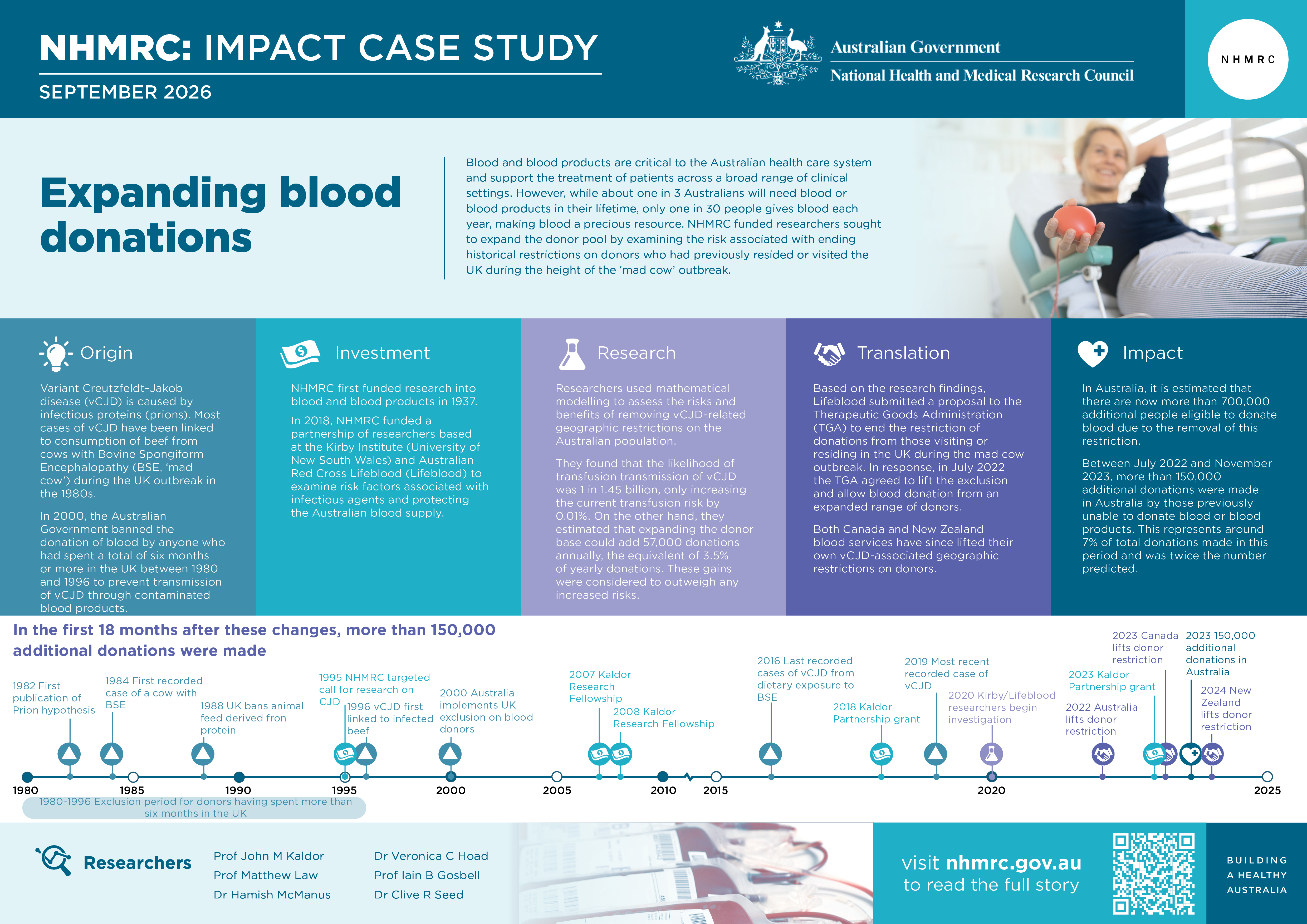
The PDF poster version of this case study includes a graphical time showing NHMRC grants provided and other events described in the case study.
Research
NHMRC-funded researchers at the Kirby Institute and Lifeblood estimated that in 2022, the regulations prohibiting the donation of blood products by those who resided for six months in the UK between 1980 and 1996 were leading to the loss of approximately 57,000 donations annually, the equivalent of 3.5% of total yearly donations.
Researchers used the latest research evidence on the occurrence of vCJD in the UK, combined with mathematical modelling, to estimate the number of undiagnosed presymptomatic cases of vCJD among people in the Australian population and the likelihood of one of these people donating blood if restrictions were removed. At 2020 risk levels, they predicted that a donation from a person exposed to the vCJD prion would occur only once in 65 years. Furthermore, this risk was mainly tied to those who had been previous long-term residents in the UK and migrated to Australia, rather than those who had travelled to the UK from Australia for tourist or working visits during the BSE outbreak.
In further modelling, the researchers estimated that the risk of developing vCJD through transfusion in Australia was 1 in 1.45 billion if the deferral for UK residence was removed. This was based on an estimated risk of contamination of a unit of blood from removing the UK 6-month residence restriction being 1 in 30 million, and risk of transmitting infection of 1 in 389 million. In repeated computer simulations to model these events, over 99% of runs generated a zero risk of vCJD transmission.7 Modelling also projected a continuing decline over time in the risk of vCJD from transfusion.
The researchers noted that their estimates and projections were conservative, in the sense that they represent upper bounds to the risk of transmission and vCJD development in blood recipients. This is because the modelling was based on UK estimates from 2010 that there remained 100 people who had been exposed to the vCJD prion and who would develop vCJD between 2011-2030 at a rate in excess of 5 per year, whereas in fact only a single case of vCJD has been reported in the UK since 2014.8 There have been no cases of transfusion-transmitted vCJD detected since the last published case in 2007 in the UK, the country in which risk would be expected to be the highest, despite more than 50 million transfusions since 2000.9
The researchers determined that the increased risk associated with the removal of BSE-related UK geographic exclusions would only add 0.01% to the baseline risk and not substantially change the overall risk of transfusions. They concluded that the benefit due to gains in donor numbers would far outweigh this minuscule increase in risk.
Translation
Kirby Institute researchers worked in partnership with researchers at Lifeblood. This collaboration ensured subject matter expertise on infectious disease transmission in blood, access to current data on blood donation for the research as well as rapid translation of findings into policy for Australia’s system of blood donation and regulation.
Shortly after the findings that the lifting of the deferral of people who had been resident in the UK for 6 or more months would pose essentially no material risk to the blood supply, Lifeblood submitted a proposal to the Therapeutic Goods Administration (TGA) to end this restriction. Based on the research and the proposal, in 2022 the TGA approved removing the deferral and allowing blood donation from an expanded range of donors. CSL Behring, the Australian based biopharmaceutical company that manufactures plasma derived medicines from donated human blood under national supply arrangements, also assessed the submission as not posing a significant risk to plasma used in the manufacturing process.
Researchers from the Kirby Institute and Lifeblood subsequently worked with the clinical team of the New Zealand Blood Service (NZBS) to estimate risks associated with vCJD in the New Zealand blood donor population. As a consequence, NZBS lifted the geographical exclusion for donors in New Zealand in early 2024.10
Outcomes and impacts
In Australia it is estimated that there are now more than 700,000 additional eligible donors due to the removal of the previous geographic restriction. In the first 6 months after the change, 38,462 newly eligible donors attended Lifeblood sites to donate. Of these, 32,358 donors made 67,914 successful donations, making up a total of 8.4% of the total collections in this period. These additional donations helped Lifeblood achieve 96% of its target collection for the period.11 This increase in donations was sustained, with more than 150,000 additional donations made in Australia by those previously unable to donate blood or blood products, between July 2022, when the UK deferral was lifted, and November 2023.12 This represents around 7% of total donations made in this period in Australia and around 13.5% of donations in Western Australia, which has a higher proportion of people with a history of UK residency.
In New Zealand, it is estimated that the vCJD related restriction caused a loss of around eight to ten percent of donors.13 With the lifting of the restriction, an estimated increase of about 10,000 donors is expected.
In Canada, since 2003, approximately 70,000 people who tried to donate blood found they were not eligible due to geographic deferrals in place at the time.14 It is anticipated that lifting of these restrictions – supported by the evidence developed by the Kirby Institute – will encourage these people and others like them to come back to donate.
Researchers
Professor John Kaldor
John Martin Kaldor received his PhD in biostatistics in 1982 from the University of California, Berkeley before continuing his research career at the International Agency for Research on Cancer in Lyon, France. He took up a position at UNSW in 1989 and has since built and led internationally recognised research programs on epidemiology and prevention of infectious disease.
Professor Matthew Law
Matthew Law completed his PhD in 1996 at UNSW where he continued his research as Head of the Biostatistics and Databases Program at the Kirby Institute. In this role he led large multinational, multidisciplinary infectious disease research collaborations of observational cohorts, clinical trials and undertook mathematical modelling to support policy and treatment guidelines.
Dr Hamish McManus
Hamish McManus completed his PhD in 2014 at UNSW. He currently works as a statistician in the Surveillance, Evaluation and Research Program at the Kirby Institute, UNSW. His work focuses on national health surveillance and uses purpose built and national datasets to investigate these issues.
Adjunct Associate Professor Veronica Hoad
Veronica C Hoad completed her Bachelor of Medicine, Bachelor of Surgery in 1998 at the University of Western Australia before going on to complete a Master of Public Health in 2008 at Curtin University. She is a fellow of the Australasian Faculty of Public Health and holds an adjunct Associate Professor position at the University of Western Australia. Her research focuses on safety of blood and blood products and risk of infectious disease. Hoad currently works in Clinical Services and Research at Lifeblood.
Professor Iain Gosbell
Iain B Gosbell completed a Bachelor of Medicine, Bachelor of Surgery in 1987 at UNSW before completing a Doctor of Medicine in 2003 at the University of Sydney. He held a position as Director of Department of Microbiology and Infectious Diseases at Sydney Southwest Pathology Service, Liverpool, until 2009 when he took up a position at Western Sydney University. He is currently Associate Dean (Academic) and Foundation Professor of Infectious Diseases and Microbiology at the School of Medicine, Western Sydney University and National Donor and Product Safety Specialist at Lifeblood.
Dr Clive Seed
Clive R Seed completed a PhD in 2010 at the University of Western Australia. He was a Senior Blood Safety Analyst at Lifeblood until he retired in 2023.
Partner
This case study was developed with input from John Kaldor, Hamish McManus and Veronica Hoad and in partnership with Kirby Institute, UNSW.

References
The information and images from which impact case studies are produced may be obtained from a number of sources including our case study partner, NHMRC’s internal records and publicly available materials. Key sources of information consulted for this case study include:
1 Australian Government Department of Health and Aged Care. What we're doing about blood and blood products [Internet]. Canberra: Australian Government Department of Health and Aged Care; [cited 2026 Aug 24]. Available from: https://www.health.gov.au/topics/blood-and-blood-products/what-were-doing-about-blood-and-blood-products
2 Australian Red Cross Lifeblood. Blood testing and safety [Internet]. Melbourne: Australian Red Cross Lifeblood; [cited 2026 Aug 24]. Available from: https://www.lifeblood.com.au/blood/blood-testing-and-safety
3 Center for Food Safety. Timeline of Mad Cow Disease Outbreaks [Internet]. Washington (DC): Center for Food Safety; [cited 2026 Aug 24]. Available from: https://www.centerforfoodsafety.org/issues/1040/mad-cow-disease/timeline-mad-cow-disease-outbreaks
4 Biacabe AG, Laplanche JL, Ryder SJ, Baron TG. Distinct molecular phenotypes in bovine prion diseases. EMBO Rep. 2004;5(1):110-115.
5Centers for Disease Control and Prevention. Diagnostic criteria for variant Creutzfeldt-Jakob disease (vCJD) [Internet]. Atlanta (GA): CDC; [cited 2026 Aug 24]. Available from: https://www.cdc.gov/prions/vcjd/diagnostic-criteria.html
6HealthLink BC. HealthFile 55b: Creutzfeldt-Jakob disease (CJD) and variant Creutzfeldt-Jakob disease (vCJD) [Internet]. Victoria (BC): HealthLink BC; [cited 2026 Aug 24]. Available from: https://www.healthlinkbc.ca/sites/default/files/documents/healthfiles/hfile55b.pdf
7McManus H, Seed CR, Hoad VC, Kiely P, Kaldor JM, Styles CE, Yang H, Law M, Gosbell IB. Risk of variant Creutzfeldt-Jakob disease transmission by blood transfusion in Australia. Vox Sang. 2022;117(8):1016-26.
8Garske T, Ghani AC. Uncertainty in the tail of the variant Creutzfeldt-Jakob disease epidemic in the UK. PLoS One. 2010 Dec 23;5(12):e15626.
9 Editorial team. Fourth case of transfusion-associated vCJD infection in the United Kingdom. Euro Surveill. 2007;12(1):E070118.4. doi:10.2807/esw.12.03.03117-en.
10 New Zealand Blood Service. Variant Creutzfeldt-Jakob disease (vCJD) and blood donation [Internet]. Auckland: New Zealand Blood Service; [cited 2026 Aug 24]. Available from: https://www.nzblood.co.nz/madcow/
11Hoad VC, Seed CR, Kiely P, Styles CE, McManus H, Law M, Kaldor J, Gosbell IB. Removal of UK-donor deferral for variant Creutzfeldt-Jakob disease: a large donation gain in Australia. Vox Sang. 2023;118(10):891-4.
12Australian Red Cross Lifeblood. 2023 stats and snacks [Internet]. Melbourne: Australian Red Cross Lifeblood; [cited 2026 Aug 24]. Available from: https://www.lifeblood.com.au/news-and-stories/vital-reads/2023-stats-and-snacks
13New Zealand Blood Service. New Zealand Blood Service lifts vCJD (mad cow) restriction [Internet]. Auckland: New Zealand Blood Service; 2024 [cited 2026 Aug 24]. Available from: https://www.nzblood.co.nz/news/2024/new-zealand-blood-service-lifts-vcjd-mad-cow-restriction/
14Canadian Blood Services. Historic change opens door to more blood and plasma donors with human variant mad cow disease risk factors [Internet]. Ottawa: Canadian Blood Services; [cited 2026 Aug 24]. Available from: https://www.blood.ca/en/about-us/media/newsroom/historic-change-opens-door-more-blood-and-plasma-donors-human-variant-mad