We're changing the way Sapphire looks
Same platform, new visual identity. Learn more: Sapphire is becoming NHMRC Grant Management System.
We're changing the way Sapphire looks
Same platform, new visual identity. Learn more: Sapphire is becoming NHMRC Grant Management System.

CEO Communique, February 2021
For peer review of 2021 Ideas Grants:
This communique presents the background and rationale for these changes, in particular:
NHMRC continues to look for ways to improve peer review, based on our own experience and that of other funding agencies internationally. Peer review by independent experts against published criteria is considered the international gold standard for allocating research grants, but there is no universally agreed best process. Design of peer review processes can reflect a range of factors, including the scope and scale of the grant scheme, assessment criteria, availability of expert reviewers, resources (funds and staff), time available to make decisions and other local or historical conditions.
In 2017-18, after the structure of the new grant program was announced, NHMRC undertook a national consultation on the design of peer review processes for the four new schemes: Investigator, Synergy, Ideas, and Clinical Trials and Cohort Studies Grants. In seeking feedback from the research sector, NHMRC emphasised that the approach to peer review needs to strike a balance between burden on the research community (applicants and reviewers) and the rigour, transparency and fairness of the process. Although responses ranged widely (see Consultation Report), a number of themes emerged in the consultation, of which the following are relevant to this communique:
Following the consultation and discussions with NHMRC’s Research Committee and other advisory committees, peer review processes for the new schemes were announced in 2018 and rolled out in the first application round in 2019.
In the first round in 2019, peer review of Ideas Grants was based on GRPs. Applications and reviewers were grouped into 39 discipline-based GRPs. Each application was then reviewed independently by four spokespersons from the GRP. Based on their scores, shortlisted applications were reviewed and rescored at a GRP meeting. Grants were awarded based on final GRP scores.
For the Investigator and Ideas Grant schemes that receive a large volume of applications, NHMRC has used ‘superpanels’ to group peer reviewers with applications based on related research topics. The superpanels have then been split into multiple smaller panels (GRPs). This maximises the ability to identify the most suitable peer reviewers for each application within the constraints of the GRP process. For more explanation, see the New Grant Program 2019: Peer Review Factsheet.
In 2019 for the first round of Ideas Grants, the peer review process was as follows:
Potential reviewers are provided with the application summary (project title, research team, administering and participating institutions, research classifications and synopsis) and asked to indicate whether they are confident in their ability to understand and assess the proposal against the assessment criteria. Four options are offered: Yes, Moderate, Low, No.
Feedback received through the Ideas Grants Panel Member Survey at the end of the round indicated that (for 367 respondents):
Comments from members who disagreed with these statements mostly reflected concerns about (1) assignment of applications to spokespersons with limited suitability, (2) the breadth of disciplines covered by their GRPs, so that members had insufficient expertise to review all applications, and (3) high workload and insufficient time to prepare. The following comments are examples.
The panels are far too broad, and encompassed many areas outside my expertise. Such panels rely on there being at least one expert for each grant - the opinion of the one individual may then sway the remaining non-experts on the panel. (Peer reviewer, Ideas Grants 2019)
The panel and grants were too diverse. ….That means that no grant is evaluated by a "panel", it's simply evaluated by the few experts in the room, and everybody else has to decide how much they trust those experts. (Peer reviewer, Ideas Grants 2019)
It was a very good idea to assign applications to four spokespersons from the panel rather than invite reviews from external assessors. However, the applications will receive a more balanced review if at least two of the four spokespersons have expertise in the area of the application, particularly the primary spokesperson. (Peer reviewer, Ideas Grants 2019)
Not all comments were negative.
I think the panel I was part of had complimentary (sic) expertise. This made for robust and fair discussion of each application from a range of perspectives. Overall I think the make up of my panel was excellent. (Peer reviewer, Ideas Grants 2019)
...I do think there are also strengths associated with having panels review a wide range of applications, which are not necessarily in the members' area of core experience. It avoids "old-boys'-networks". But it does definitely increase the workload for the panel members. (Peer reviewer, Ideas Grants 2019)
Analyses of the impact of panel discussions on application scores in the 2019 Ideas Grant and Investigator Grant rounds are presented in Appendix B.
For Ideas Grants, the data showed that spokespersons most commonly reduced their scores for an application (usually for a single criterion by a single point) and the remainder of the panel most commonly reduced the application score further as a result of discussion at a GRP meeting. As a result, average spokesperson scores declined for ~58% of applications and final scores declined for 75% of applications compared with average pre-GRP spokesperson scores. For most of the remaining applications (37%), the average spokesperson score increased at the GRP meeting; however, despite the generally higher suitability of spokespersons than other panel members for each grant, fewer grants received a higher final score from the panel as a whole (25%).
An alternative approach to panel discussion was trialled in the 2019 Investigator Grant round – discussion by exception. Few applications were nominated for discussion and the impact on funding outcomes was modest (affecting 0.6% of applications) for the extra burden on reviewers and the time added to the review process.
The 2019 experience with Ideas Grants highlighted the following points:
In 2020, GRP meetings were removed from the peer review process for the Ideas Grant scheme because of the COVID-19 pandemic. This change significantly reduced the workload for peer reviewers and saved about 3 months, enabling the release of outcomes in 2020. By eliminating the need to group reviewers and applications into GRPs, there was more flexibility to match four suitable reviewers to each application.
In early 2020, there was widespread concern that it would be impossible to deliver a major grant scheme during the pandemic because applicants, peer reviewers, and both institutional and NHMRC staff would be affected by illness, caring responsibilities, changed professional roles (such as front-line clinical and public health activities) and closure of workplaces.
As the Ideas Grant round was already underway during the first pandemic wave, NHMRC extended the submission deadline from early May to mid-June to give applicants more time and removed GRP meetings from the process to maximise the chance of delivering outcomes by the end of the year (see CEO Communique, May 2020. Many peer reviewers withdrew during 2020 due to competing demands. Nevertheless, thanks to the extraordinary efforts of 585 reviewers to deliver almost 12,000 individual Ideas Grant reviews, outcomes were released under embargo on 30 November 2020.
GRP meetings add about 3 months to the process for a large scheme like Ideas Grants (see GRP workload below for more detail). For this reason, outcomes of the 2020 Ideas Grant round would not have been available until February/March 2021 if GRP meetings had been held.
The removal of GRP meetings provided an opportunity to trial an ‘application-centric’ approach to the selection of peer reviewers in the 2020 Ideas Grant round. Without the need to group applications and reviewers into GRPs (the ‘panel-centric’ approach used in 2019), applications were matched to reviewers from a bigger pool, providing more options to optimise their suitability. For more information about this process, see Appendix A.
The following process was used:
Feedback received through the Ideas Grants Panel Member Survey at the end of the round indicated that (for approximately 300 respondents):
Common concerns expressed by members were:
GRP meetings allow all scoring to be justified and disagreements to be considered and balanced. (Peer reviewer, Ideas Grants 2020)
The panel discussions are very useful to talk through the grants - the shared perspectives can have a big impact on the scoring (e.g. one individual may spot a significant weakness in the grant that others can then attest to, thus reducing the score or a strength overlooked by others may be proposed by a panel member and generate robust discussion resulting in an increased score and the important work funded). I would strongly encourage that panels remain an integral part of the review process. (Peer reviewer, Ideas Grants 2020)
Panels can monitor rogue assessors. (Peer reviewer, Ideas Grants 2020)
On the other hand, many members commented that the absence of GRP meetings helped them to manage workloads and other responsibilities, including parenting.
Not needing to attend panel meeting was beneficial to my family commitments and schedule. (Peer reviewer, Ideas Grants 2020)
The absence of the meetings allowed me to participate from interstate, otherwise I would have been excluded, so thank you. (Peer reviewer, Ideas Grants 2020)
Some noted that they were confident in their scoring without discussion and that GRPs can be dominated by individual panel members.
Views of dominant members of GRPs can overly influence other scores. (Peer reviewer, Ideas Grants 2020)
I do not think the panels provide good input for the time and expense. None of the panel comments are provided to applicants. The 2 panels I was part of in previous years were heavily influenced by 1 or 2 outspoken individuals who wanted their views heard. At least without panel, people are able to do their own individual assessments without influence. (Peer reviewer, Ideas Grants 2020)
I thought having no panel was an improvement. I don't think it is necessary to discuss grants in person, I think most people can do scoring properly if trained. (Peer reviewer, Ideas Grants 2020)
Many thought it would be ideal to combine application-centric reviewer selection with retaining GRP meetings. (It is important to note that this would only be possible if each combination of spokespersons comprised its own GRP, membership of which would overlap with other GRPs. If most applications had a unique combination of spokespersons, the number of GRPs would approach the number of applications and conventional meetings would not be feasible.)
BOTH - the system is open to rorting as no justification is required where panel is missing and panel discussions are very helpful in refining the scores. BUT - panel is heavy influenced by loud, unchecked personalities so bias there anyway. Either way - the best grants typically get funded. (Peer reviewer, Ideas Grants 2020)
Panel can help to reach fair outcome but it can also distort it if individual panel members "dominate" the discussion. There are arguments to support and oppose both solutions (even if we assume that the same reviewers would review an application) but the fact that without panels the reviewers are more likely to be experts outweighs the disadvantages of the lack of the panel discussion. (Peer reviewer, Ideas Grants 2020)
Both NHMRC’s data (based on reviewers’ declared suitability before peer review) and responses to the Panel Member Survey suggested better matching of reviewers to applications in 2020 than in 2019 (Appendix A).
The 2020 experience with Ideas Grants highlighted the following points:
Important changes will be made to the peer review process for Ideas Grants in 2021:
Application-centric reviewer selection means that the five best available reviewers will be identified for each application, where ‘best’ means that suitability is maximised while avoiding COI. Compared with panel-centric reviewer selection required to form GRPs (as in 2019), this approach increases flexibility in the choice of reviewers. As each application can have a unique combination of reviewers, there is better matching of reviewers to individual applications and better use of reviewer expertise (Appendix A).
The peer review process will be as follows:
The introduction of written feedback to applicants in the 2020 Investigator Grant round was well received with 70% of respondents to the Peer Reviewer Survey reporting that summary statements very much or somewhat improved the fairness/robustness of peer review. Comments highlighted the importance of reviewers justifying their scores and the value of feedback for the applicant.
Although the workload for each reviewer is substantial, we hope that the streamlining of peer review to the single-step process outlined here will make it easier to engage a large group of suitable reviewers.
Additional support will also be available to peer reviewers in 2021:
The decision to use independent assessments without GRP meetings is a very important one. The reasons are outlined in the next section.
The following table presents the main advantages and disadvantages of independent assessments with and without GRP meetings, based on NHMRC’s experience together with formal and informal feedback from applicants, peer reviewers, Research Committee and other advisory committees.
| Independent assessments without GRP meetings | Independent assessments with GRP meetings | |
|---|---|---|
| Advantages |
|
|
| Disadvantages |
|
|
Whether they are held in person or virtually, GRP meetings add about 3 months to the peer review process for a large scheme like Ideas Grants, with the following steps:
Feedback from peer reviewers through the Panel Member Survey after the 2019 Ideas Grant round provided the following information on the workload attributable to GRP meetings:
Noting the balance of advantages and disadvantages outlined above, NHMRC considers that independent assessments without GRP meetings (allowing application-centric reviewer selection) will improve the quality of peer review of Ideas Grant applications – especially by improving the matching of peer reviewer expertise to applications across all fields and by enabling true independence of peer review.
In 2021, as in 2020, using this approach will also increase flexibility to manage continuing impacts of the COVID-19 pandemic on the peer review process and the likelihood of delivering grant outcomes by the end of the year.
Independent assessment without GRP meetings has already been introduced for Investigator Grants, with five assessors per application and written feedback to applicants. With our experience so far, we think that this approach is especially suitable for schemes that receive large number of applications (1780 for Investigator Grants and 2955 for Ideas Grants in 2020) across the full breadth of health and medical research fields. The disadvantages of GRP meetings (requiring panel-centric reviewer selection) are most obvious for these large schemes because of the challenges of forming panels with appropriate specificity and breadth of expertise. By contrast, NHMRC plans to continue using GRPs for smaller schemes, including the Clinical Trials and Cohort Studies Grant scheme.
In moving to application-centric reviewer selection without GRP meetings for Ideas Grants, there are issues to understand and manage:
Several approaches are in place or in development to manage these issues, for example:
The Peer Review Analysis Committee has now met three times. Members are working closely with the Office of NHMRC on data analysis and modelling of de-identified peer reviewer scores from the Investigator and Ideas Grant schemes to investigate issues such as the impact of divergent scores on outcomes and variations between reviewers in score distribution. We anticipate releasing a report on this work once it is complete. Advice from this committee and from Research Committee will help to inform the management of scores in the future.
In implementing these changes, NHMRC will ask all peer reviewers to participate in a post-review survey as usual to seek feedback on the process used in 2021. The outcomes of the survey will be considered along with analysis of data from the round to evaluate the effectiveness of the new process. NHMRC will also continue to welcome feedback from the research sector on their experience as grant applicants, reviewers and administrators.
NHMRC has two motivations in making these changes to the peer review process for Ideas Grants.
The first is to continue to improve the quality and robustness of peer review.
The second is to streamline the peer review process.
We see independent assessment by multiple well-matched reviewers, without the constraints of GRP meetings, as a significant step forward in the design of a rapid, flexible process for expert peer review in this important grant scheme.
Potential peer reviewers were identified from self-nominations and awardees of 2018 Project Grants and 2019 Ideas Grants and based on specific expertise requirements.
All potential peer reviewers were asked to screen a large set of grant applications on their assigned superpanel (based on discipline groupings) and to declare for each application:
With the aim of maximising suitability and minimising conflicts of interest, these declarations were used for:
| Parameter | 2019 | 2020 |
|---|---|---|
| Applications received | 2739 | 2995 |
| Peer reviewers approached to provide declarations | 736 | 602 |
| Peer reviewers selected for assessment1 | 568 | 585 |
| Number of applications per spokesperson/peer reviewer2 | 18-22 | 25-30 |
| Number of applications per GRP (after NFFC) | 23-31 | |
| Number of reviewers per GRP | 13-16 | Not applicable |
| Number of reviews received per application | 4 reviews: 97.6% 3 reviews: 2.4% | 4 reviews: 99.4% 3 reviews: 0.6% |
| Total number of reviews received | 10868 | 11954 |
| Declared suitability | 2019 | 2020 |
|---|---|---|
| Yes | 4101 (37.7%) | 8095 (67.7%) |
| Moderate | 5744 (52.9%) | 3824 (32.0%) |
| Limited | 1020 (9.4%) | 34 (0.3%) |
| No | 3 (0.03%) | 1 (0.01%) |
| Total | 10868 | 11954 |
All Ideas Grant peer reviewers were invited to complete a survey after they had completed peer review in 2019 and 2020. In both years, reviewers were asked how well the applications assigned to them matched their expertise.
| Parameter | 2019 | 2020 |
|---|---|---|
| Number of peer reviewers | 568 | 585 |
| Q21: To what extent do you agree with the following statement: In general, the applications assigned to me as Spokesperson (2019)/assessor (2020) matched my area/s of expertise. | ||
| Number of respondents | 367 | 303 |
| Strongly Agree | 28(7.6%) | 63(20.8%) |
| Agree | 161(43.9%) | 163(53.8%) |
| Neither agree nor disagree | 80 (21.8%) | 49 (16.2%) |
| Disagree | 76 (20.7%) | 24 (7.9%) |
| Strongly disagree | 22 (6.0%) | 4 (1.3%) |
| Q33: If you were also an assessor in the 2019 Ideas Grants round, was the suitability of applications assigned to you in 2020 overall better compared with the suitability of applications assigned to you in 2019. | ||
| Number of respondents | Not applicable | 300 |
| Yes | 136 (45.3%) (66.3%) | |
| No | 50 (16.7%) (24.4%) | |
| Not applicable | 95 (31.7%) (n/a) | |
| Unsure | 19 (6.3%) (9.3%) | |
Conclusion: Both NHMRC’s data (based on reviewers’ declared suitability before peer review – Table 2) and the survey data (based on respondent reviewers’ general perception after peer review – Table 3) suggest better matching of applications to peer reviewers in 2020 using application-centric reviewer selection than in 2019 using panel-centric reviewer selection.
Data are presented here on the impact of panel discussion on scores in the 2019 Ideas Grant and Investigator Grant rounds.
The 2019 Ideas Grant round used a two-step process with panel-centric reviewer selection. In the first step, each application was scored independently by 3-4 reviewers (spokespersons). In the second step, each short-listed application was discussed by the full GRP at a face-to-face meeting. All GRP members, including spokespersons, scored the application during the meeting.
Of the original 2739 applications, 1001 were discussed at a GRP meeting; these applications had received a total of 3973 independent assessments before the GRP meeting.
The figure below shows the difference between spokesperson (SP) scores before and after discussion at a GRP meeting for each of the assessment criteria (Research Quality [35%], Innovation and Creativity [25%], Significance [20%] and Feasibility [20%]) for all short-listed applications (n=1001).
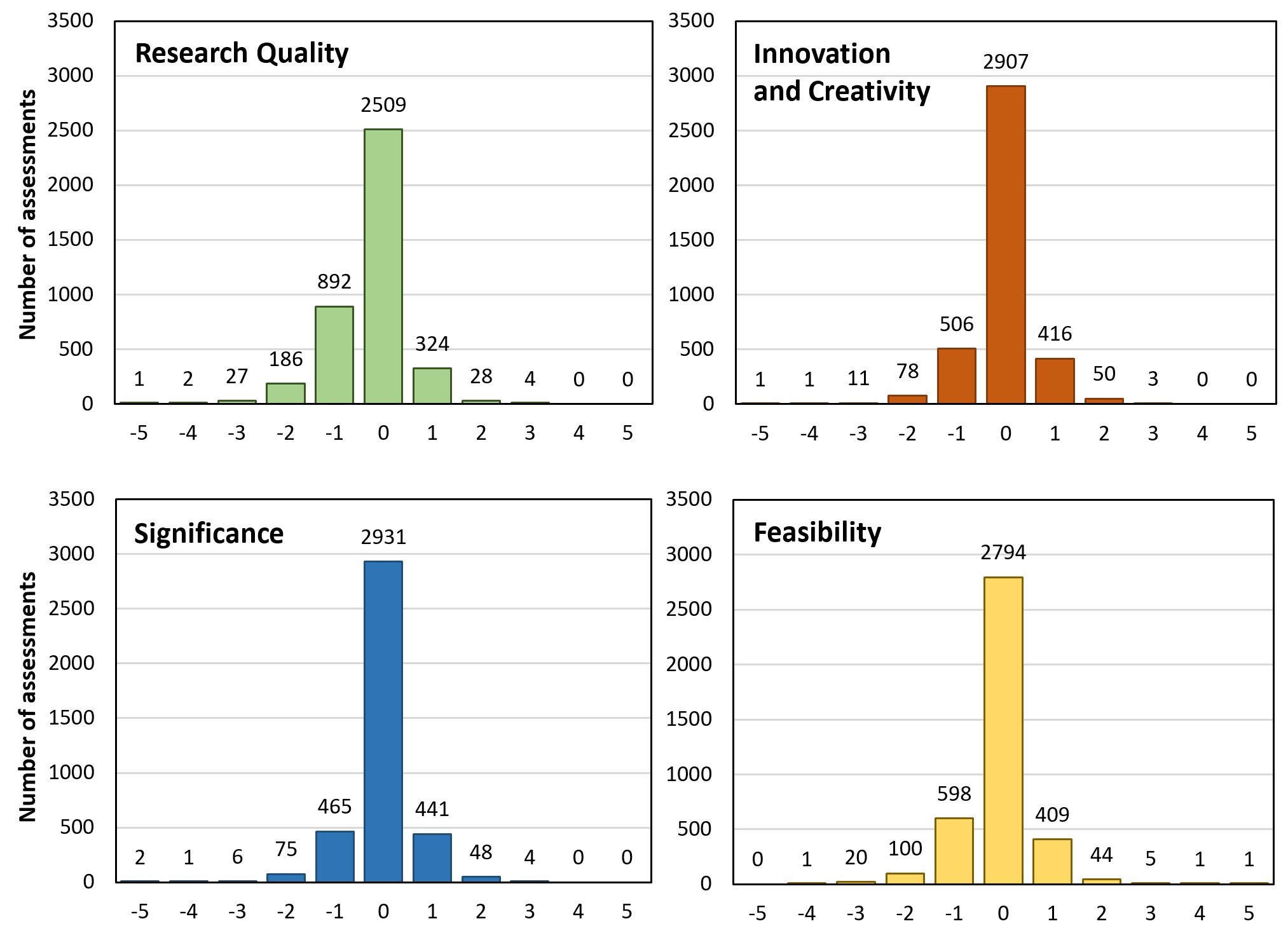
The table below shows the number of criteria for which spokespersons changed their scores as a result of discussion at a GRP meeting.
| Parameter* | Number of criteria for which score was changed | |||||
|---|---|---|---|---|---|---|
| 0 | 1 | 2 | 3 | 4 | Total | |
| Number of spokesperson assessments | 1,380 | 1,231 | 778 | 372 | 212 | 3,973 |
| Percentage of spokesperson assessments | 34.7% | 31.0% | 19.6% | 9.4% | 5.3% | 100% |
*Incomplete assessments were not included in this analysis.
Together the data in Figure 1 and Table 2 show:
The figure below shows the difference between the average spokesperson score for each short-listed application before and after the GRP meeting (n=1001). The green shading shows applications whose average spokesperson score increased at the GRP meeting.
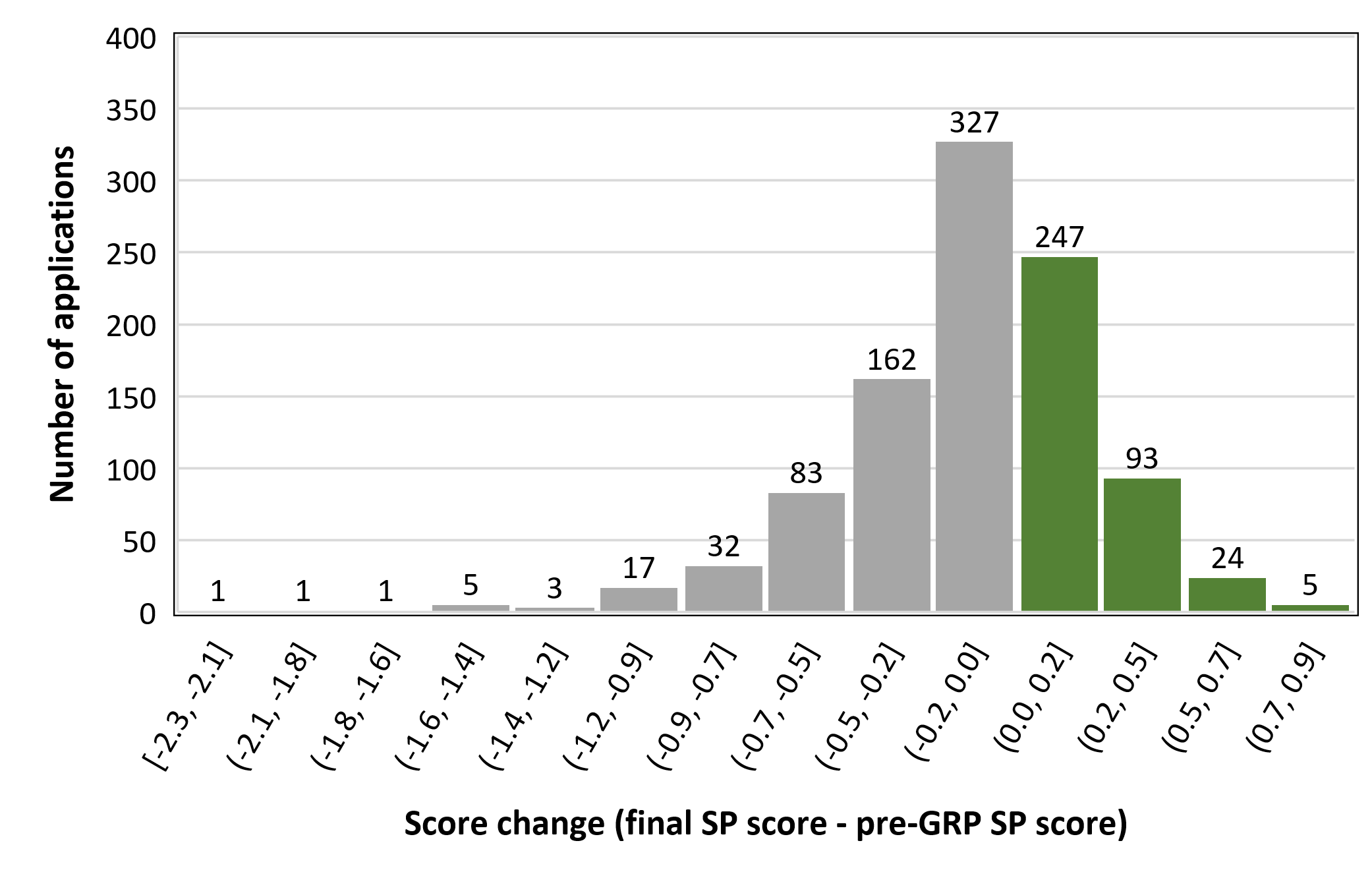
The data show:
The figure below shows the difference between the average spokesperson score for each short-listed application before the GRP meeting and the final application score provided by the whole panel (3-4 spokespersons and about 11 other members) at the GRP meeting. The green shading shows applications whose average score increased at the GRP meeting.
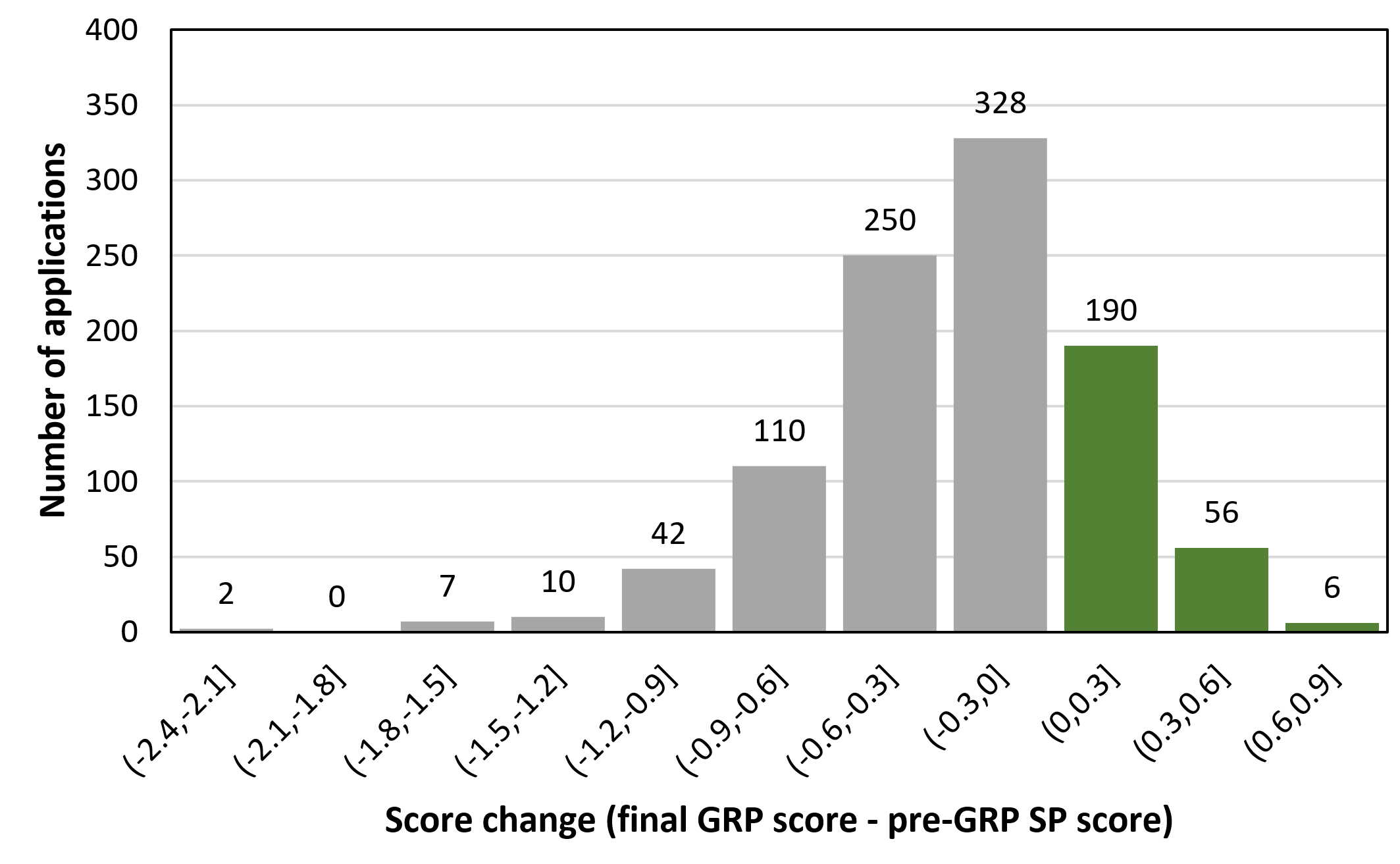
The data show:
Taken together, Figures 2 and 3 show that discussion at GRP meetings most commonly led to spokespersons lowering their scores and that other GRP members most commonly amplified this effect by lowering the scores further. However, when the spokespersons increased their scores at the GRP meeting, other panel members did not invariably follow and fewer grants received a higher score from the whole panel than from the spokespersons.
The impact of these score changes on funding outcomes is difficult to measure because of: (1) the inclusion of rescued applications in the shortlist discussed at GRP meetings, (2) the post-GRP removal of applications that became ineligible when applicants were awarded an Investigator Grant, and (3) the fact that not all budgets are discussed at the GRP meeting while others have their budgets reduced, allowing additional applications to be funded.
“Discussion by Exception” was trialled in the first round of the Investigator Grant scheme in 2019. It is an alternative approach to GRP meetings in which only those applications that require discussion are considered by a panel. In principle, depending on how many applications are discussed, this approach can be implemented even when application-centric reviewer selection is used and each application has a unique group of reviewers.
In the 2019 Investigator Grant round, five independent assessments were sought for each of the 1857 applications received; 87% received five and the remainder received four assessments. Each reviewer was assigned 24-39 applications.
Once they had seen the aggregated independent scores from all reviewers for their assigned applications, reviewers could nominate a maximum of two applications for discussion by exception. The panel of reviewers for each nominated application then met by videoconference with an independent chair and a community observer. The reviewer who nominated the application opened the discussion with the justification for their nomination. Following discussion, reviewers had the opportunity to re-score the application.
The outcomes were as follows:
Of 185 respondents to the Peer Reviewer Survey, 42% agreed or strongly agreed that Discussion by Exception was an important part of the peer review process. Among concerns noted was the inequity of discussing and re-scoring only selected applications.
Conclusion: Few applications were nominated for discussion. Although most were re-scored, Discussion by Exception had a modest effect on funding outcomes for the extra burden on reviewers and the time added to the review process.
| SP score change | Number of assessments |
|---|---|
| -5 | 1 |
| -4 | 2 |
| -3 | 27 |
| -2 | 186 |
| -1 | 892 |
| 0 | 2509 |
| 1 | 324 |
| 2 | 28 |
| 3 | 4 |
| 4 | 0 |
| 5 | 0 |
| SP score change | Number of assessments |
|---|---|
| -5 | 1 |
| -4 | 1 |
| -3 | 11 |
| -2 | 78 |
| 1 | 506 |
| 0 | 2907 |
| 1 | 416 |
| 2 | 50 |
| 3 | 3 |
| 4 | 0 |
| 5 | 0 |
| SP score change | Number of assessments |
|---|---|
| -5 | 2 |
| -4 | 1 |
| -3 | 6 |
| -2 | 75 |
| 1 | 465 |
| 0 | 2931 |
| 1 | 441 |
| 2 | 48 |
| 3 | 4 |
| 4 | 0 |
| 5 | 0 |
| SP score change | Number of assessments |
|---|---|
| -5 | 0 |
| -4 | 1 |
| -3 | 20 |
| -2 | 100 |
| 1 | 598 |
| 0 | 2794 |
| 1 | 409 |
| 2 | 44 |
| 3 | 5 |
| 4 | 1 |
| 5 | 1 |
| Score change (final SP score - pre-GRP SP score) | Number of applications |
|---|---|
| (-2.3, -2.1] | 1 |
| (-2.1, -1.8] | 1 |
| (-1.8, -1.6] | 1 |
| (-1.6, -1.4] | 5 |
| (-1.4, -1.2] | 3 |
| (-1.2, -0.9] | 17 |
| (-0.9, -0.7] | 32 |
| (-0.7, -0.5] | 83 |
| (-0.5, -0.2] | 162 |
| (-0.2, 0.0] | 327 |
| (0.0, 0.2] | 247 |
| (0.2, 0.5] | 93 |
| (0.5, 0.7] | 24 |
| (0.7, 0.9] | 5 |
| Score change (final SP score - pre-GRP SP score) | Number of applications |
|---|---|
| (-2.4, -2.1] | 2 |
| (-2.1, -1.8] | 0 |
| (-1.8, -1.5] | 7 |
| (-1.5, -1.2] | 10 |
| (-1.2, -0.9] | 42 |
| (-0.9, -0.6] | 110 |
| (-0.6, -0,3] | 250 |
| (-0.3, 0] | 328 |
| (0, 0.3] | 190 |
| (0.3, 0.6] | 56 |
| (0.6, 0.9] | 6 |