
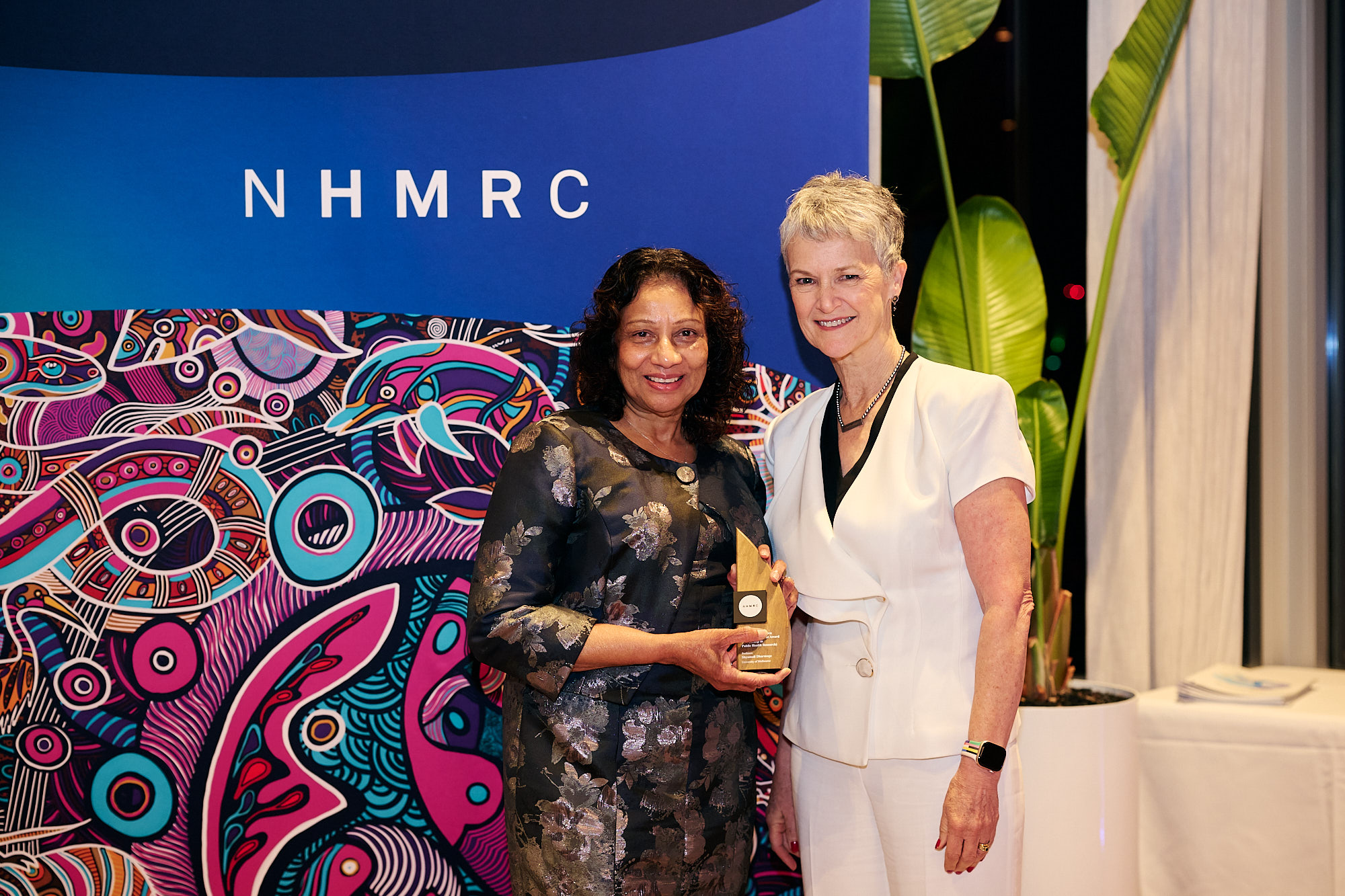
Professor Shyamali Dharmage, Head of the Allergy and Lung Health Unit and Deputy Director (Research) of the Centre for Epidemiology and Biostatistics, School of Population and Global Health at The University of Melbourne, is redefining chronic obstructive pulmonary disease (COPD) as a preventable life course condition, shifting the focus from late diagnosis to early intervention. Professor Dharmage is the recipient of the NHMRC Elizabeth Blackburn Investigator Grant Award (leadership in public health) for her research into early detection and interventions to stop pre-COPD.
Healthy lungs are fundamental to healthy ageing, workforce participation and national productivity.

My journey began in rural Sri Lanka, inspired by a local general practitioner whose compassionate care transformed lives. Years later, as a young doctor and mother, that calling took on new meaning. When both of my young children became critically ill with severe pneumonia and spent weeks in intensive care, with one later developing a chronic lung condition, my perspective changed profoundly.
I began asking not only how we treat lung disease, but how we prevent it. That turning point redirected my career in clinical practice to a lifelong commitment to lung research in the early 1990s.
After migrating to Australia in 1995, I immersed myself in longitudinal studies, determined to understand how we can prevent chronic lung disease before it becomes irreversible. A defining moment in my career came in 2000, when the late Professor John Hopper entrusted me with leadership of the Tasmanian Longitudinal Health Study (TAHS), one of the world’s most important life course cohorts.
Established in 1968, TAHS has followed thousands of participants and their families from childhood. I have since led the revitalisation and expansion of the study, following participants into their 60s through 7 follow ups.
With the latest phase scheduled for completion in 2029, we continue to generate world leading evidence on how lungs grow, reach their peak and decline across the lifespan.
The greatest beneficiaries of this research will be children exposed to early disadvantage, individuals living with asthma, communities whose lungs are affected by environmental risks, and ageing Australians vulnerable to chronic lung disease. By intervening earlier, we can shift outcomes not just for individuals, but for generations.
Our findings thus far have challenged the long held assumption that COPD is simply a smoker’s disease of midlife.
In a world first study nested within TAHS, we identified distinct lung function trajectories across the first 6 decades of life and demonstrated that most adults with COPD have disease pathways that begin decades before diagnosis, often in early childhood. This research helped establish the now recognised pre-COPD paradigm, shifting international thinking toward earlier detection and prevention.
The 2025 NHMRC Investigator Grant will build on that foundation. We will identify early markers of risk, test interventions designed to halt progression in pre-COPD and develop predictive tools that allow clinicians to intervene before irreversible damage occurs.
My goal is simple but ambitious: that fewer children grow into adults with compromised lung health, and that future generations experience less avoidable breathlessness and disability.
Running long term cohort studies takes a village, and I acknowledge the many collaborators and funding bodies who have made this work possible. Resilience, collaboration and long-term vision have driven my success, and I remain deeply committed to mentoring the next generation of researchers and research fellows who will continue to push boundaries in preventive medicine.
As I often say, if we understand the beginnings of disease, we can change its ending.
Being ranked the top Investigator Grant applicant for leadership in public health pillar is both an honour and a responsibility. I see this award not only as recognition of sustained scientific contribution, but as a powerful opportunity to accelerate a prevention focused agenda that challenges how we think about chronic lung disease in Australia and globally.